
Products Compared
Binance Stocks vs Traditional Brokers: Key Checks
Compare Binance Stocks with a traditional broker by legal entity, custody chain, SIPC limits, funding costs, order tools, portability and dispute route.
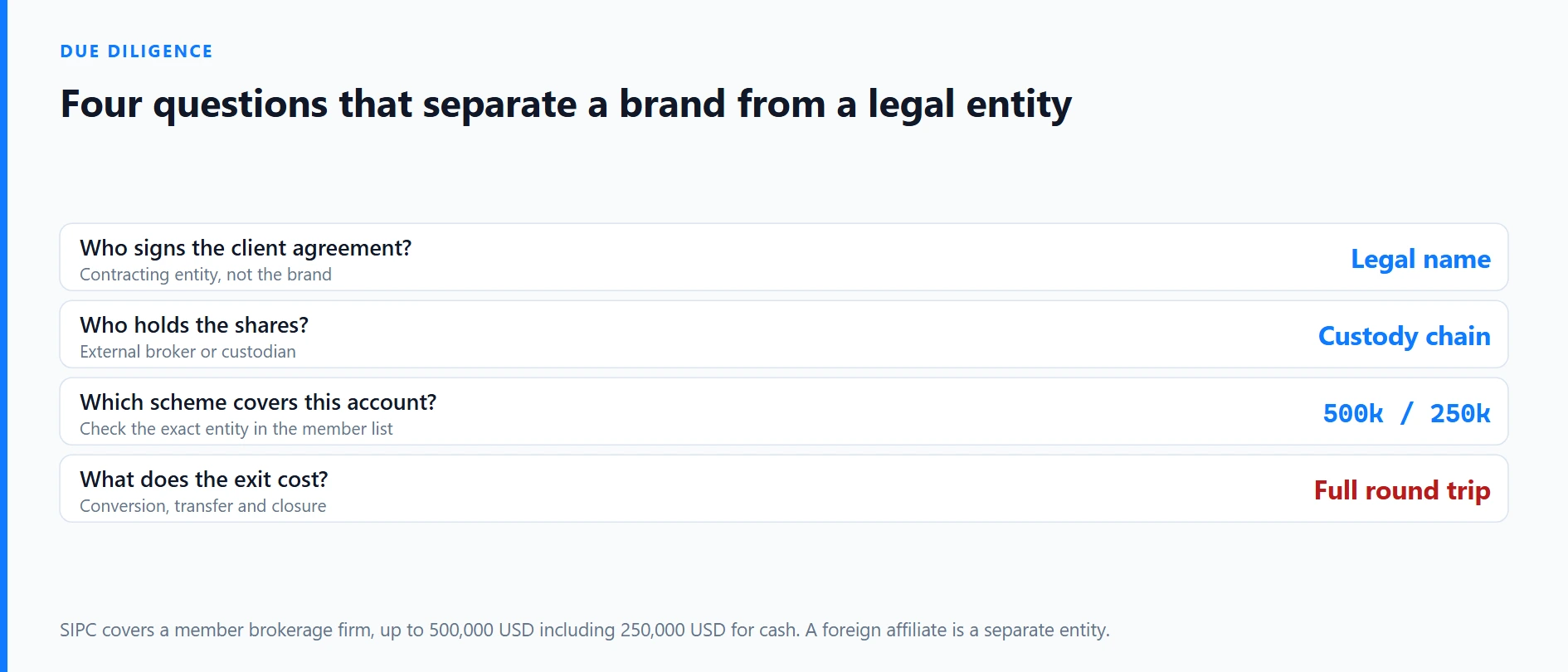
Last fact check: October 8, 2026. This comparison does not name a universal winner. Its purpose is to replace brand-level assumptions with documents that identify the legal entity, custody chain, protection scheme, full cost and exit route for a specific account.
Binance Stocks can make it convenient for an eligible user to place stock and ETF orders with assets already held in a crypto account. A traditional broker may offer bank funding, more markets, tax reports and account-transfer infrastructure. Neither label alone establishes better protection. The useful comparison is between the actual contracts and services available to the same person in the same jurisdiction.
Table of contents
- Start with a decision matrix
- Identify the legal entity
- Map the custody chain
- Interpret SIPC correctly
- Compare the full cost path
- Match tools to the intended use
- Test account portability
- Score the evidence
Quick decision matrix
| Due-diligence area | Ask about Binance Stocks | Ask about a traditional broker |
|---|---|---|
| Contracting entity | Which company provides the account and the Stocks service? | Which licensed company signs the client agreement? |
| Custody | Which external broker or custodian holds the shares? | Who is the introducing broker and clearing broker? |
| Ownership record | How are beneficial ownership and corporate-action rights recorded? | Are assets held in street name, nominee form or direct registration? |
| Protection | Which compensation scheme covers the exact legal entity and assets, if any? | Does SIPC or a local scheme cover this exact account? |
| Funding | What is the full USDC or crypto-conversion cost? | What are the bank, card and foreign-exchange costs? |
| Orders | Which order types and sessions apply to this instrument? | Which stop, conditional, recurring or tax-lot tools are supported? |
| Portability | Can whole and fractional positions move without a sale? | Is ACATS or another in-kind transfer route available, and at what fee? |
| Records | What statements show conversion, fees, dividends and withholding? | Which confirmations and tax reports remain available after closure? |
The matrix is an initial filter, not a verdict. Open the underlying agreements and regulator records before assigning a score.
1. Separate the legal entity from the brand
Binance's current Stocks guide says the service is provided by Nest Trading Limited in partnership with an external brokerage. It describes the user as beneficial owner of shares held in custody by the brokerage partner. That description does not establish that every account uses the same law, complaint process or compensation arrangement as a domestic brokerage account.
The Binance page also lists regulated activities for its ADGM entities, including activities attributed to Nest Trading Limited. Regulation is relevant evidence, but it is not interchangeable with a promise that every product, balance or customer is protected by a particular compensation scheme.
A traditional brokerage brand can also operate through different national subsidiaries. Copy the company name, registration number, regulator and legal address from the client agreement. Confirm those details in the regulator's own register rather than relying on an app-store publisher name, logo or search advertisement.
If the product is visible but the contracting entity is unclear, ask support for the account-specific terms before depositing. Do not use a VPN, false address or another person's identity to make a product appear available.
2. Map the custody and clearing chain
Investor.gov explains that a client-facing broker can maintain an account itself or use another firm for clearing and custody. Securities are frequently held in street name: the investor is shown as owner in the broker's books while the registered holder is the broker or its nominee.
Map at least four roles:
- the entity signing the client agreement;
- the platform accepting the order;
- the broker executing and clearing the trade;
- the custodian or depository maintaining the asset record.
Ask whether customer securities are segregated from company assets, whose statement is the authoritative custody record, and what process applies if one intermediary stops operating. “I own the share” is an economic conclusion, not a complete custody map.
Binance Stocks, bStocks and stock perpetuals must not be collapsed into one category. Binance Stocks describes brokerage-held beneficial ownership. bStocks are blockchain certificates with a separate issuer and prospectus. Stock perpetuals are derivatives with funding and liquidation. The three-product comparison explains those boundaries.
3. Interpret SIPC protection correctly
Investor.gov says SIPC can help address a shortfall in securities and cash when a SIPC-member brokerage firm fails. The stated limit is up to 500,000 USD per customer, including a 250,000 USD limit for cash claims. SIPC does not insure ordinary market loss, an unsuitable investment or a promised return.
The legal entity matters. Investor.gov explicitly notes that an affiliate, parent or foreign subsidiary is a separate entity and is not a SIPC member unless independently registered. A customer of a foreign subsidiary is therefore not protected merely because another company in the group is a member.
Do three checks rather than repeating a logo:
- identify the entity that carries or holds the account;
- search that exact legal name in the official SIPC member list;
- confirm whether the relevant securities and cash are customer property at that member.
This article does not confirm that a Binance Stocks account or its external brokerage partner has SIPC protection. It also does not extend a securities-account conclusion to USDC, bStocks, perpetual contracts or other crypto assets. Each entity, account capacity and asset must be analyzed separately.
A non-US broker may have a different statutory compensation system with different limits and exclusions. Record the scheme name, legal basis, covered failure event, asset scope and claims process. None of these schemes protects the market value of a declining stock.
4. Calculate the complete funding and exit cost
“Zero commission” is not the same as zero cost. Model the same amount through both routes:
Income currency → funding asset → share → sale proceeds → income currency
For Binance Stocks, include bank or fiat on-ramp cost, crypto spread, network or transfer cost, conversion to USDC, the Stocks platform fee or spread, market bid/ask spread, applicable ADR charges, withdrawal or off-ramp costs and tax-record work. The current guide says purchases settle primarily in USDC and supported assets such as BNB and USDT can be converted at order submission. The USDC, USDT and BNB funding guide shows how to trace that path.
For a traditional broker, include bank-wire or card cost, foreign-exchange markup, trading or exchange fees, account or data fees, transfer fees and any tax-reporting service. A “free” local deposit can still be paired with a wide currency conversion margin.
Use the actual preview and final statement rather than a marketing fee table alone. Run a small, permitted test and record the amount that leaves the original currency, the share value received, every fee, sale proceeds and the amount that returns to the original currency.
5. Match order and session tools to the use case
Binance's guide describes market and limit orders. Market orders are active only during regular US trading hours, while eligible limit orders can participate in selected extended or overnight sessions. DAY and GTC instructions are available under stated conditions; GTC can remain active up to 90 days and is not available for fractional orders.
A traditional broker may offer stop, stop-limit, trailing, conditional, recurring, tax-lot, options or bond tools. A longer feature list is not automatically better. Check whether the few controls required by the intended strategy are reliable and understandable.
Session access also affects execution quality. Thin overnight liquidity and wider bid/ask spreads can matter more than a small headline fee. If market versus limit, DAY versus GTC, or regular versus overnight remains unclear, use the order-type guide before comparing platforms.
Compare the exact ticker, exchange, share class and fractional availability. Catalog size does not prove that the particular security, order type or session needed by the investor is supported.
6. Test the transfer and account-closure scenario
Investor.gov says a transfer is normally initiated through the new firm and, in the US system, may be sent through ACATS. It also warns that firms can charge transfer fees and that the receiving broker may not accept every security. When an asset cannot move in kind, selling it can add fees, taxes and time out of the market.
Ask for written answers before opening the account:
- Can whole shares transfer to another broker without sale?
- What happens to fractional positions?
- Are open orders required to be cancelled first?
- Which transfer, closure or wire fees apply?
- How long should the transfer take, and how are errors escalated?
- How long do statements and tax documents remain accessible after closure?
A bStock blockchain withdrawal is not a brokerage-account transfer. A token movement changes wallet custody but does not convert the certificate into a directly registered company share.
After any transfer, compare the first statement from the new firm with the final statement from the old firm, including quantity, cost basis and cash. Preserve both outside the platform account.
7. Compare support, security and the dispute route
Having phone, chat and email buttons is not enough. Identify the language of support, the legal entity receiving a complaint, response deadlines, arbitration clause, court venue and regulator escalation route.
Compare authentication, passkeys or strong 2FA, device management, withdrawal-address controls, recovery procedures and API permissions. A crypto-linked account introduces withdrawal and API risks that a bank-funded broker may handle differently. Use the account security checklist before a material balance is deposited.
Ask one product-specific question through official support and preserve the case number. The quality of an answer about custody, statements or transfers is more informative than response speed to a generic password question.
Build a scored comparison
Give each candidate 0, 1 or 2 points for legal entity, custody, investor protection, full cost, order tools, transfers, tax records, support and security: 0 means missing or unsuitable evidence, 1 means partially satisfactory, and 2 means the requirement is documented and met.
Weight the categories before scoring. A long-term investor may weight custody, statements and portability more heavily; a small experimental account may weight minimums and usability. If the legal entity or custody chain remains unclear, a high total from convenience features should not override that missing foundation.
Binance Stocks may suit an eligible user who wants a small fractional-share order funded from existing supported assets. A traditional broker may be stronger for bank funding, broader products or in-kind portfolio transfers. Using both can reduce dependency on one platform, but increases recordkeeping, security workload and operational complexity.