
Orders & Costs
How to Fund Binance Stocks With USDC, USDT or BNB
Map Funding and Spot balances, USDC settlement, USDT or BNB conversion, unused balances, failed orders and full round-trip costs before a stock order.
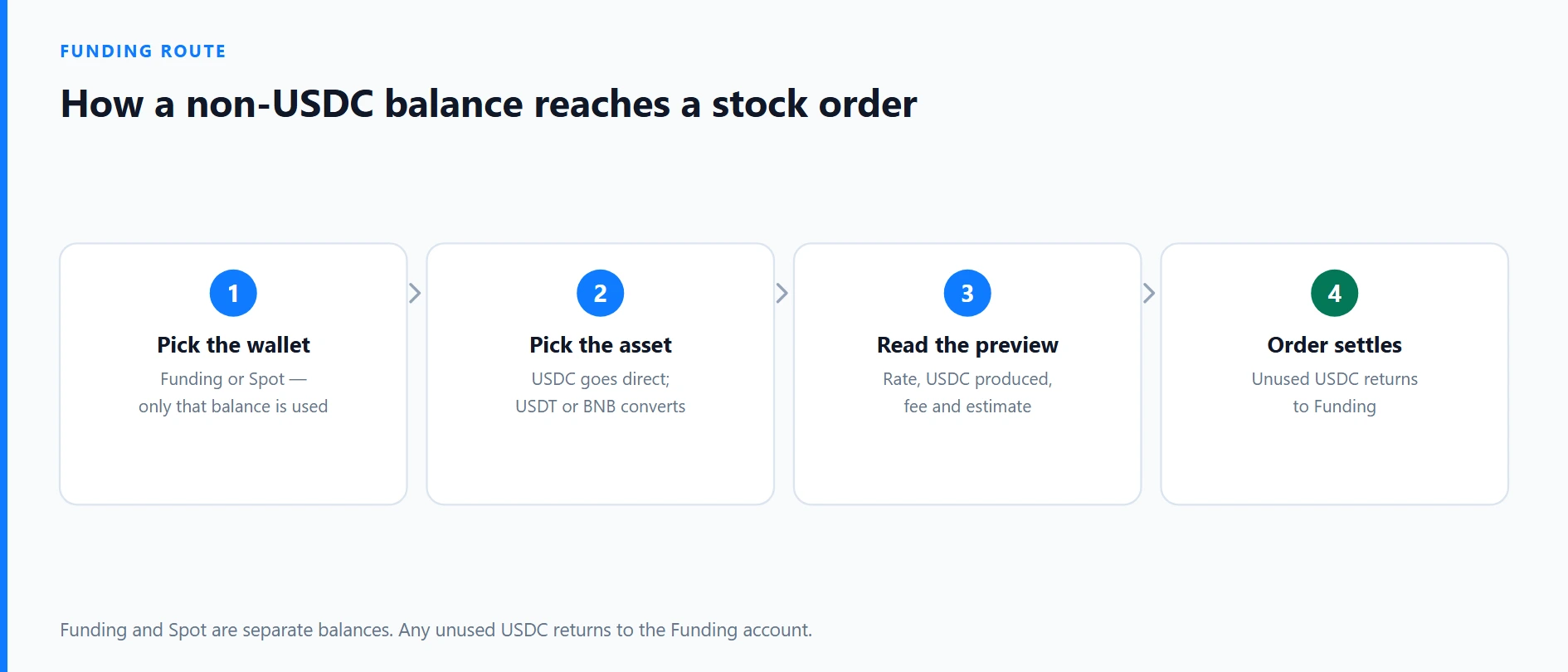
Last fact check: August 24, 2026. Binance Stocks can show a share value in US-dollar terms while taking a supported crypto asset from Funding or Spot. Binance's current guide says stock orders settle primarily in USDC, and a supported non-USDC asset can be converted when the order is submitted.
That flow may contain two separate transactions: a conversion from the funding asset to USDC, followed by the USDC-funded share order. Keep the conversion, share value, fee and unused balance separate so a simple “$100 stock purchase” does not conceal the actual cost.
Table of contents
- Map each funding route
- Separate Funding and Spot
- Use USDC directly
- Preview a USDT or BNB conversion
- Follow a numerical example
- Trace a failed order
- Calculate the full round trip
- Test and preserve records
Funding route map
| Selection | What can happen at order time? | Main check |
|---|---|---|
| USDC | The stock order uses the primary settlement asset directly | Platform fee, spread, estimate and remainder |
| USDT, BNB or another supported asset | The required portion can be converted into USDC | Source amount, conversion rate, received USDC and unused USDC |
| Funding account | Only available balance in the selected Funding account is used | Correct wallet and sufficient free balance |
| Spot account | Only available Spot balance is used | Open-order locks and any required internal transfer |
The funding control is not merely a payment preference. It determines which ledger is checked and where to investigate if a balance appears missing.
Funding and Spot are separate balances
If the same asset is divided between Funding and Spot, a stock order sees the available balance in the selected source rather than automatically combining both wallets. The total shown elsewhere in the account can look sufficient while the chosen source remains short. Check for assets locked in open Spot orders and make an internal transfer only if the order preview requires it.
Binance's Stocks guide says USDC proceeds from a share sale are returned to the Funding account. Therefore, a purchase funded from Spot does not imply that later sale proceeds will appear in Spot. Compare official order history, conversion history and wallet statements rather than relying on two balance screenshots taken at different times.
Funding directly with USDC
Selecting USDC can avoid an additional source-asset conversion, but it does not make the stock trade cost-free. The preview can still include the platform fee, market spread, fractional-share rounding and an estimate that changes before execution.
Read the word estimated carefully. A market order seeks immediate execution, so its final average price is known only after fills occur. A limit order sets a price boundary, but it does not guarantee any fill or a complete fill. Confirm the order type, share quantity, trade value, fee and total debit as separate fields.
The product's stated minimum threshold and its fee are different concepts. Binance's current guide describes a 5 USD-equivalent minimum order amount; meeting that threshold does not imply a 5 USD fee. The fee shown for a particular preview should be checked against the live product schedule and final execution record.
When USDT or BNB is selected
The current Binance guide lists USDC, BNB, USDT, U and USD1 as supported payment assets, subject to account and regional availability. When a non-USDC asset is selected, the platform can attempt to convert the amount required for the stock order.
Separate these fields on the preview screen:
- the source asset and quantity to be debited;
- the applied or estimated conversion rate;
- the amount of USDC produced;
- the stock trade value;
- the platform fee and estimated total;
- the destination for any unused USDC.
If BNB moves before confirmation, the BNB quantity required for the same share order can move too. That is an additional price exposure that is not visible on the company's share chart. Refresh a stale preview and do not infer an exchange rate from the approximate USD label alone.
For current Stocks charges, Binance's guide describes a 0.35 USD platform fee for orders up to 350 USD, and a 0.1% spread for orders above 350 USD. Other costs can include conversion spread, market spread, ADR fees where applicable, taxes and fees imposed by third parties. Schedules can change, so record what the live preview and final statement actually show. The Binance Stocks fee guide separates these layers in more detail.
Hypothetical numerical example
This example is not a live quote or fee schedule. Suppose an order needs about 100 USDC and the user selects USDT. The preview shows:
- 100.40 USDT to be debited;
- 100.10 USDC after conversion;
- 99.70 USDC as stock trade value;
- 0.35 USDC as the estimated platform fee;
- 0.05 USDC returned as unused balance.
The arithmetic reconciles as 99.70 + 0.35 + 0.05 = 100.10 USDC. The record still needs both units: 100.40 USDT left the source wallet, while 100.10 USDC entered the order flow. Recording only “bought $100 of stock” loses the conversion difference, the share value and the fee.
This also illustrates why cost percentage can be high on a small order. A fixed 0.35 charge on 99.70 of share value is about 0.35% before conversion or market spread. That observation is arithmetic, not a recommendation to increase order size.
What happens if the stock order fails?
Binance's guide states that any unused converted USDC is returned to Funding. If a source-asset conversion appears in history but the stock order does not complete, inspect the records before assuming the whole flow was reversed. The official wording does not promise an automatic conversion back into the original USDT or BNB.
Check two separate records:
- the stock order status in order history;
- the converted USDC balance and entry in Funding history.
Do not conclude that “nothing happened” merely because no share was acquired. The source-asset exposure and accounting record may already have changed. Before placing another order, identify the returned USDC so an unnecessary second conversion is not triggered.
Calculate the complete round-trip cost
Do not stop the comparison at purchase:
Local currency → source asset → USDC → share → USDC → source asset or local currency
For each arrow, note any bank or fiat spread, crypto conversion rate, network charge, Stocks platform fee, market spread and tax-record event. A sale creates its own price and fee record; converting or withdrawing the USDC proceeds can add another layer.
The currency, dividend and tax checklist explains why the purchase, income and disposal records should not be collapsed into one number. Tax treatment depends on jurisdiction and individual facts, so preserve source documents for a qualified local review.
Run a small test and preserve records
For a new payment asset or wallet source, test the complete flow near the permitted minimum before using a material amount: internal transfer, preview, conversion, share order, sale and return of USDC. The purpose is to learn the ledger path, not to prove that future prices or availability will be identical.
Save these items for each step:
- transaction or order ID;
- UTC timestamp and local-time reference;
- source asset, quantity and conversion rate;
- USDC received, share quantity and average fill;
- each fee or withholding entry;
- Funding or Spot source and final destination;
- CSV or statement export when available.
A screenshot is useful visual evidence but does not replace the structured order and wallet history. Statements make it easier to explain later why Funding and Spot balances differ.
Before the first real order, use the eligibility and order-preview checklist to confirm that the product, legal disclosures and instrument label are actually available in the verified account.