
Orders & Costs
US Stock Settlement: Trade Date, T+1 and Buying Power
Why a sale shows up as cash you cannot withdraw, how many business days you really have to pay, and the three cash-account mistakes that trigger a 90-day restriction.
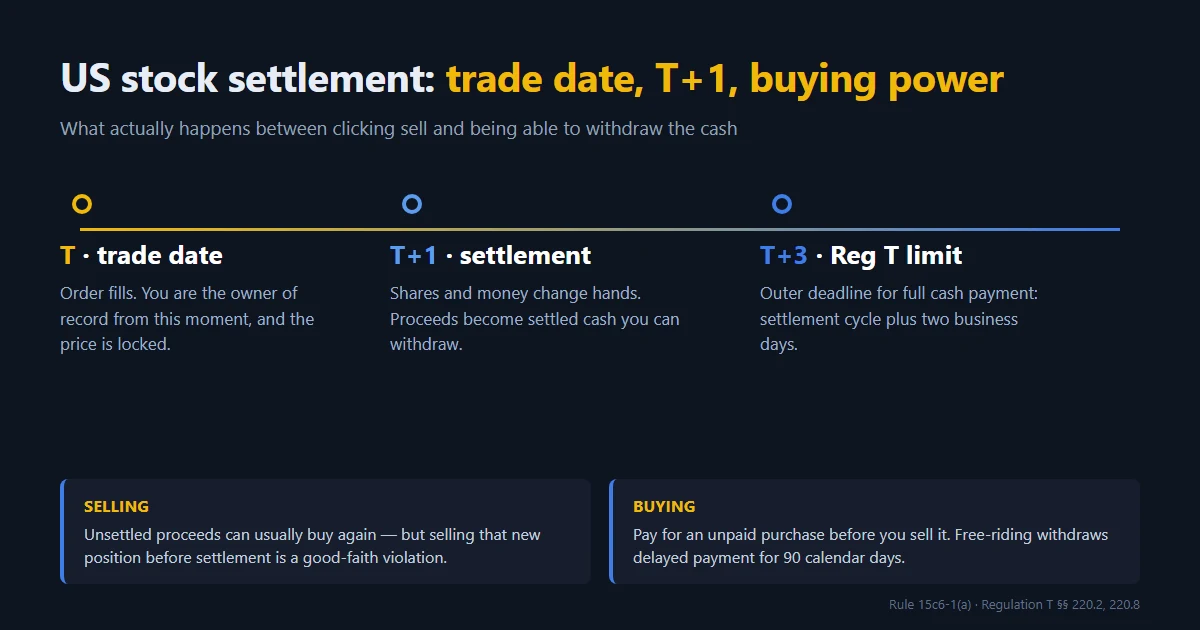
You sell 12 shares at 14:05, the cash appears in your account a second later, and the withdraw button rejects it. Nothing is broken. The number you are looking at is a promise the clearing system has not kept yet, and the rules that decide when it becomes real money are short enough to read in full.
Trade date and settlement date are two different events
The trade date, written as T, is the moment your order fills. Price, quantity and your ownership rights are fixed right there — a buyer on the trade date is the economic owner even though nothing has physically moved.
The settlement date is when the exchange of securities for money actually completes between the two brokers through the clearing system. Since 28 May 2024, the US standard is one business day after the trade date. The rule itself, 17 CFR § 240.15c6-1(a), is a single sentence:
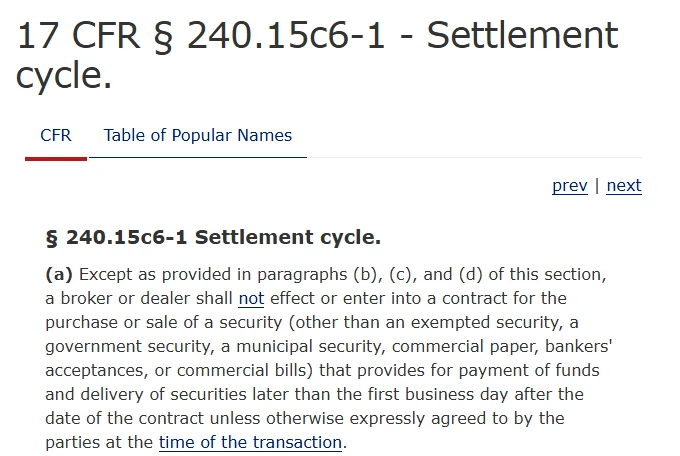
Two details in that sentence matter more than the "T+1" label:
- "first business day" — not 24 hours. Weekends and US market holidays do not count. Sell on Wednesday 25 November 2026 and settlement lands on Friday 27 November, because Thanksgiving Thursday is a market holiday.
- "unless otherwise expressly agreed" — T+1 is the default, not a ceiling. Both sides can agree to a different date at the time of the transaction.
The rule also carves out whole categories: exempted securities, government and municipal securities, commercial paper, bankers' acceptances and commercial bills sit outside paragraph (a). Paragraph (b) adds unlisted limited partnership interests and security-based swaps. Paragraph (c) lets a firm-commitment offering priced after 16:30 ET settle on the second business day. If you only trade listed shares and ETFs, none of this touches you; if you buy new issues or Treasuries, check the confirmation rather than assuming.
Settled cash, unsettled proceeds and what you can do with each
Your account can show one balance and three different permissions attached to it.
Settled cash has completed its cycle. You can trade it, withdraw it, or leave it. No restrictions.
Unsettled proceeds are the money from a sale that has not reached its settlement date. In a cash account almost every broker lets you buy again immediately with those proceeds — that part is normal and allowed. What is not allowed is selling the new position before the old sale settles. The industry name for that is a good-faith violation: the broker extended you credit in good faith, and you disposed of the position before making good on it.
Unpaid purchases are the mirror image. Regulation T § 220.8(b) requires your broker to obtain full cash payment within one payment period, and § 220.2 defines that period as the standard settlement cycle plus two business days — three business days from the trade date under T+1. Miss it and § 220.8(b)(4) tells the broker to promptly cancel or liquidate the position, though amounts under 1,000 USD may be disregarded.
In practice no broker waits for the regulatory ceiling. House rules usually demand payment by settlement, and the outer T+3 limit only shows up when a bank transfer is late.
A worked example, with the dates written out
Assume a cash account with 2,000 USD settled, and a normal week with no holidays.
| Day | Action | Settled cash after |
|---|---|---|
| Monday | Buy 1,000 USD of stock A | 1,000 USD |
| Monday | Sell stock B for 1,500 USD proceeds | 1,000 USD settled + 1,500 unsettled |
| Tuesday | Both Monday trades settle | 2,500 USD |
Now change one thing. On Monday you use the 1,500 USD of unsettled proceeds to buy stock C, and on Monday afternoon stock C jumps 4% so you sell it. Stock B has not settled yet — it settles Tuesday. You have sold a position paid for with money that does not exist until tomorrow. That is the good-faith violation. The consequence is set by the broker rather than by the regulation: most firms record the violations and, after a small number of them inside a rolling twelve months, restrict the account to settled cash for 90 days. You can still trade under that restriction, but every purchase has to be covered by money already through the cycle. The thresholds differ between brokers, so the count that matters is the one in your account agreement.
The harsher version is free-riding, and it is written directly into the regulation. § 220.8(c)(1) says that if an unpaid security is sold or delivered to another broker before full payment is received, the privilege of delaying payment beyond the trade date is withdrawn for 90 calendar days. That is not a courtesy restriction — it is the rule.
The third pattern rarely gets named. You buy on Monday intending to wire money on Tuesday, the wire is late, and the broker sells something else in the account to cover the purchase. The cover sale itself does not settle until the next business day, so the purchase was never funded with settled money at the moment it was due. Repeated cover sales carry the same 90-day outcome at most brokers.
Why your buying power changes the instant a position moves
Cash accounts and margin accounts answer the settlement question in opposite ways.
In a cash account, buying power is settled cash plus, in most cases, unsettled proceeds you have not yet re-sold. The cycle is the constraint.
In a margin account, sale proceeds normally become available as margin buying power immediately, because the broker is lending against the account rather than waiting for the clearing system. Selling a position bought with unsettled funds does not create a good-faith violation there. You have traded a settlement constraint for a credit relationship, with interest, maintenance requirements and the possibility of a forced sale attached — which is a different set of risks, not an absence of risk.
If you are sizing positions around what you can deploy this week, the account type changes the answer more than the stock does. That question belongs with the rest of your pre-trade checks, alongside how market and limit orders behave on an exchange account.
What T+1 changed for dividends
Under the old T+2 cycle, the ex-dividend date fell one business day before the record date, because a buyer on the ex-date would not settle in time to appear on the books. With a one-day cycle that gap closed. For distributions with record dates from 29 May 2024 onward, the ex-date and the record date are normally the same business day — buy on the ex-date and you do not receive the dividend; buy the business day before and you do.
The practical effect is that the window for a dividend-capture decision is now a single session instead of two, and any dividend calendar you saved before mid-2024 is using the old convention. How the payment then reaches you — full share, fractional entitlement, cash residual — depends on the product, which is covered in the guide to fractional shares, dividends and stock splits.
Tokenized and exchange-traded stock products are a separate system
None of the above automatically applies to a tokenized share product. Rule 15c6-1 governs brokers and dealers effecting contracts in securities; an on-chain token that tracks a share price moves on the blockchain's own confirmation schedule, and what you are holding may be a claim on a custodian rather than the share itself. Transfers can look instant while the underlying share still settles on a conventional cycle somewhere behind the product.
That difference changes what "settled" means for you, so read the product's own documentation instead of assuming the T+1 timetable — the distinctions are set out in what bStocks actually represent in terms of ownership and backing.
Five checks before your next trade
- Know which balance you are spending. Find the settled-cash figure in your account, not the total. If the platform does not show one, ask support where it is.
- Do not sell what unsettled money bought. In a cash account, wait for the original sale to settle before closing the new position.
- Fund purchases before settlement, not before the T+3 ceiling. Bank transfers across borders routinely miss a one-day window.
- Count business days, not days. Check the exchange holiday calendar before any trade placed around a holiday or a long weekend.
- Read the free-riding restriction as calendar days. The 90 days in § 220.8(c)(1) are calendar days, not business days, and they start from the violation rather than from the day you notice it.
Settlement mechanics also decide when a quoted price stops being a quote and becomes your cost. The other half of that question is the spread you crossed on the way in, covered in how liquidity sets your real trading cost.
Sources
- 17 CFR § 240.15c6-1, Settlement cycle — Cornell Legal Information Institute
- 12 CFR § 220.2 and § 220.8, Regulation T definitions and cash account — 220.2, 220.8
- SEC press release 2023-29, adoption of the T+1 settlement cycle with a 28 May 2024 compliance date — sec.gov
- DTCC, T+1 Conversion Guide, March 2024, on ex-date and record date alignment — dtcc.com
Regulation text and dates verified 20 September 2026. Broker house rules are stricter than the regulatory minimums described here and change without notice; your account agreement governs.