
Orders & Costs
Bid-Ask Spread: How Liquidity Sets Your Real Trading Cost
The spread never appears on a confirmation, but on a thin stock it costs more than every visible fee combined. How to convert it into a percentage, why it widens, and how to check what your fill really cost.
Last fact check: September 19, 2026. Rule references below come from the SEC's own adopting releases, staff guidance and compliance guides, and from the FINRA rulebook. Compliance dates under Regulation NMS have already been moved once and can move again; check the linked source before relying on a date.
A commission shows up on the confirmation. The spread does not. It is taken at the moment of the fill, in the price itself, and on a thinly traded stock it can be several times larger than every visible fee combined.
Table of contents
- See what the two quoted prices mean
- Convert the spread into a percentage
- Know what makes a spread widen
- Understand the floor set by tick size
- Check what you actually paid
- Apply the controls that reduce the cost
- Avoid the common mistakes
The two prices behind one quote
A stock quote is two numbers, not one. The bid is the highest price someone is currently willing to pay for the shares. The ask (or offer) is the lowest price someone is currently willing to sell them at. The SEC defines the difference between the two as the spread.
The bid is always the lower number. That gap is not a fee anyone charges you; it is the price of demanding immediacy. A buyer who wants shares right now takes the ask. A seller who wants out right now takes the bid. Whoever is on the other side of both trades collects the difference for standing ready.
This matters for a specific reason: a market order buys you certainty of execution, not certainty of price. The SEC puts it plainly — a market order executes at the best available price, and that price is not guaranteed. The quote you saw and the price you got are two different things, and the spread is most of the distance between them.
Read the spread as a percentage, not in cents
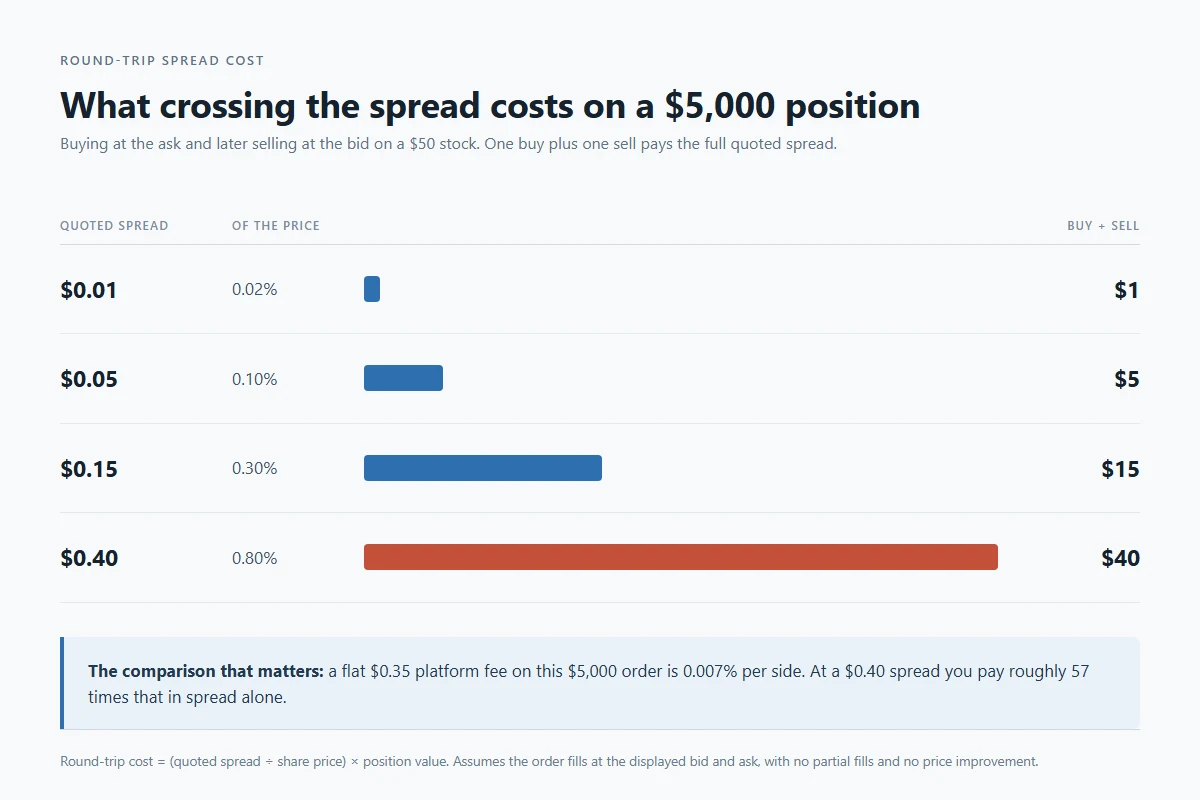
Four cents sounds small. Whether it is small depends entirely on the share price. Four cents on a $400 share is 0.01%. Four cents on a $6 share is 0.67% — sixty-seven times heavier for the same position value.
The arithmetic is short:
Round-trip spread cost = (quoted spread ÷ share price) × position value
One buy and one sell pays the full spread once. A single entry, with no exit yet, costs about half of it relative to the midpoint.
The last row is the one worth sitting with. On a $5,000 position, a forty-cent spread costs roughly fifty-seven times what a flat $0.35 order fee costs. If you are comparing venues purely on the published fee schedule and its 0.35 USD minimum, you are comparing the smaller number.
The same math explains why spread cost punishes frequency rather than size. Ten round trips at 0.30% is 3% of the position gone before any view about the company has been tested.
What makes a spread widen
Spreads are not a fixed property of a stock. They move with conditions, and four of them do most of the work.
How many shares sit at the top of the book. If only 100 shares are quoted at the best bid, an order for 800 shares eats into worse prices behind it. The quoted spread understates what a larger order actually pays.
Volatility. Whoever quotes both sides carries the risk of being picked off when news lands. Higher uncertainty means a wider gap as compensation.
Time of day. The first and last minutes of the regular session absorb overnight orders and closing-auction flow. Quotes are unstable in both windows.
Whether the regular session is open at all. FINRA's extended hours disclosure rule states the mechanism directly: "Lower liquidity and higher volatility in extended hours trading may result in wider than normal spreads for a particular security." The same rule lists lower liquidity as its own named risk. If you are placing orders in a pre-market or overnight session, assume the spread is wider than the number you remember from midday.
The rule that sets the floor on tight quotes
There is a regulatory floor on how tight a US quote can get, and it changed recently. In September 2024 the SEC adopted amendments to Rule 612 of Regulation NMS adding a $0.005 minimum pricing increment for NMS stocks priced at or above $1.00. Which increment a stock gets is not chosen by the exchange — it is assigned from the stock's own Time Weighted Average Quoted Spread during a defined evaluation period.
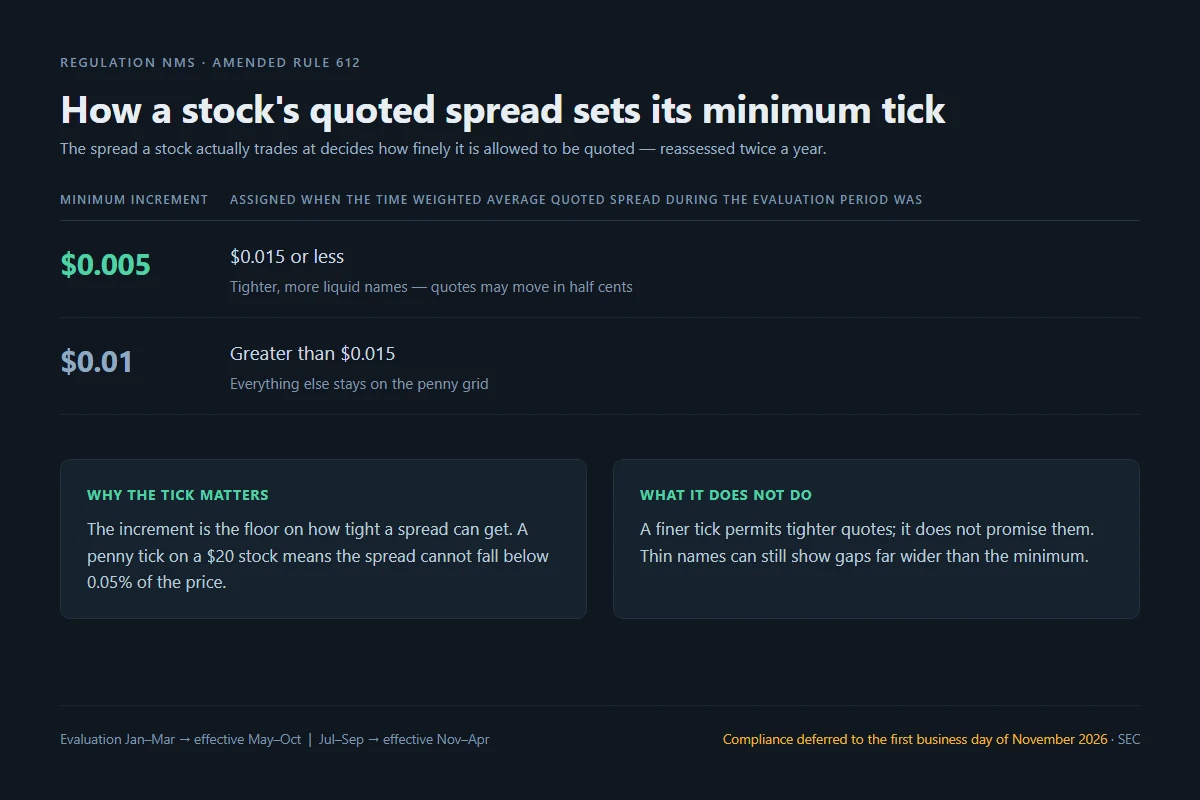
Two practical points. First, the tick is a floor, not a promise: a finer increment permits a tighter quote without producing one, and illiquid names will still show gaps far wider than the minimum. Second, the timing is unsettled. The SEC issued an exemptive order on October 31, 2025 extending compliance for Rules 600(b)(89)(i)(F) and 612 to the first business day of November 2026. Treat any article that states an earlier date as out of date.
Check what you paid, not what was quoted
The honest way to judge spread cost is after the fact, against the midpoint that existed when your order arrived. That measure is the effective spread, and as of August 1, 2026 it is considerably easier to find.
That is the compliance date for the amended Rule 605 of Regulation NMS — the first substantive rewrite of the order execution disclosure rule since 2000. Under it, market centers publish monthly execution quality reports, and broker-dealers that introduce or carry 100,000 or more customer accounts must prepare reports for their own broker-dealer function. Alongside effective spread, quoted spread and price improvement, the amended reports add realized spread over additional time horizons and a percentage measure of average effective spread divided by average quoted spread.
That last ratio, often written E/Q, is the one to learn. Below 100% means orders on average filled inside the quoted spread. At or near 100% means they filled at the quote. It lets you compare two venues without their share prices distorting the comparison, which raw cent figures cannot do.
These reports cover US market centers. They will not describe an exchange-issued tokenised product, and no equivalent disclosure currently exists for one — a gap worth weighing when you compare that route with a conventional brokerage account.
Controls that cut spread cost
- Use a limit order when the spread is wide. It caps what you pay and refuses the worst prints. The trade-off is a possible non-fill, which is exactly the trade-off described in the comparison of market and limit orders.
- Check displayed size before sizing the order. If the top of the book is thinner than your intended order, split it rather than sending it whole.
- Skip the first and last few minutes unless you have a reason to be there.
- Convert the spread to a percentage and compare it to your expected holding return. A 0.6% round trip is noise on a two-year thesis and ruinous on a two-day one.
- Re-check the spread on the exit, not just the entry. Liquidity that existed when you bought may not be there when you sell — that is when spread cost usually surprises people.
Mistakes that quietly add cost
Treating a zero-commission venue as a zero-cost venue. Judging a spread in cents without dividing by the price. Assuming a stock's midday spread applies at 4:30 in the afternoon. Sizing an order against average daily volume instead of the shares actually quoted at the top of the book. And reading a limit order's unfilled status as a failure, when refusing a bad price is the whole point of using one.
Sources
- SEC, Tick Sizes — A Small Entity Compliance Guide: sec.gov
- SEC press release 2024-137, minimum pricing increments and access fee caps: sec.gov
- SEC press release 2025-130, exemptive order on Regulation NMS compliance dates: sec.gov
- SEC staff, Frequently Asked Questions: Rule 605 of Regulation NMS: sec.gov
- FINRA Rule 2265, Extended Hours Trading Risk Disclosure: finra.org
- SEC, Spread and Bid-Ask Spread glossary entries: investor.gov