
Orders & Costs
Binance Stocks Market vs Limit Orders
Compare Binance Stocks market and limit orders across regular, extended and overnight sessions, including DAY/GTC, gaps, partial fills and fractions.
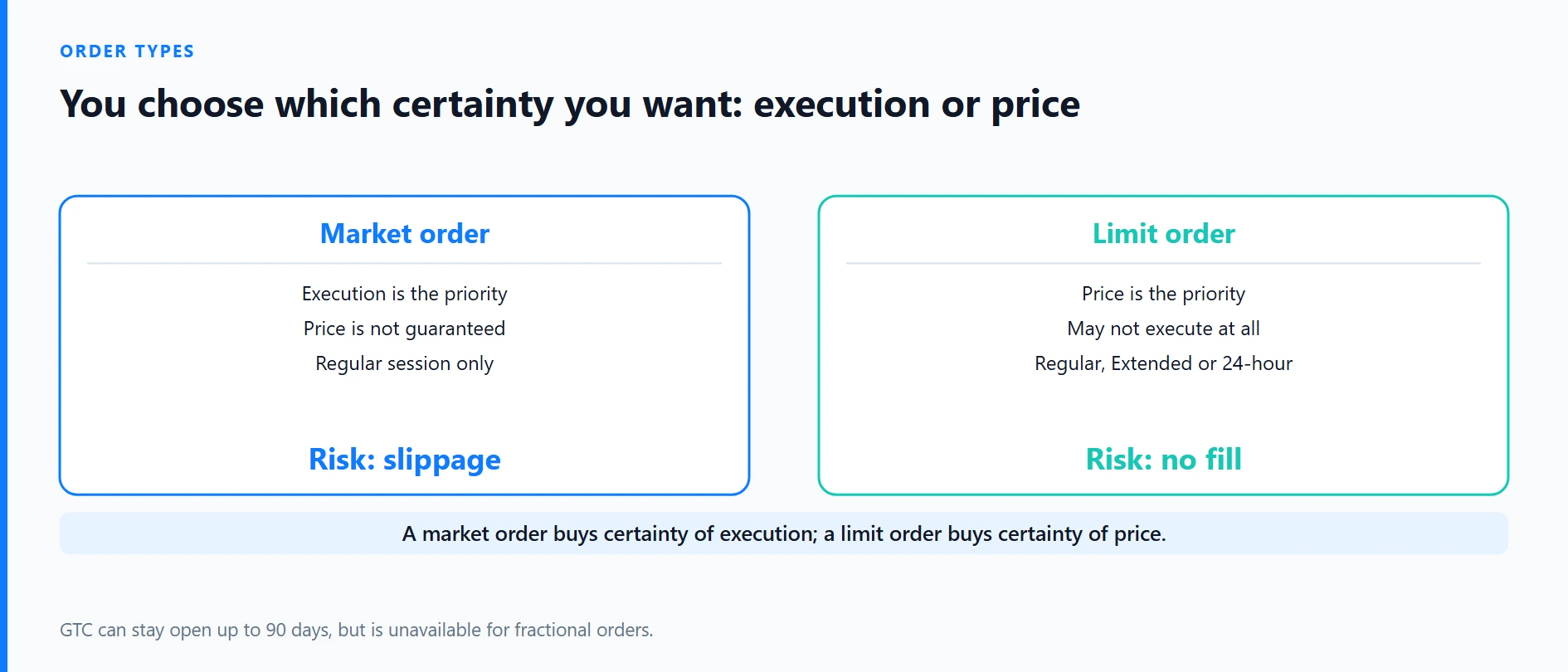
Last fact check: August 24, 2026. An order type is an execution instruction, not a prediction. A market order prioritizes getting the trade done when it becomes active; a limit order sets a price boundary. Neither chooses a good company, controls position size or guarantees a profitable result.
On Binance Stocks, the choice also interacts with the selected US trading session. Market orders are active only during Regular Trading Hours, while eligible limit orders can participate in selected extended or 24-hour sessions. Always read the current instrument's preview because session and fractional-order support can vary.
Table of contents
- Compare market and limit quickly
- Understand market-order risk
- Understand limit-order trade-offs
- Choose DAY or GTC
- Work through common scenarios
- Reconcile preview and execution
Quick comparison
| Question | Market order | Limit order |
|---|---|---|
| Price guaranteed? | No; seeks the best available prices when active | Should not execute worse than the limit, but may not execute |
| Binance Stocks session | Regular Trading Hours | Regular, Extended or selected 24-hour session, depending on settings |
| Main risk | Slippage and opening gap | No fill or partial fill |
| Time in force | Check the live preview and queued status | DAY or GTC; GTC up to 90 days and unavailable for fractional orders |
| Best fit | Execution matters more than a small price difference | Maximum buy price or minimum sell price must be controlled |
Before choosing either, confirm that the screen is the direct Stock product rather than a bStock or stock perpetual. The same company ticker can appear in products with different order books and risks.
How a market order works
A market order reaches for the best available prices in the order book when the instruction becomes active. The last price on a chart is not a guaranteed execution price. Investor.gov notes that a market order generally executes near the current ask for a purchase or bid for a sale, but the last-traded price can differ from the eventual fill.
Available quantity matters. Suppose the best ask shows 20 shares at 100.00 and the next level shows 80 at 100.20. A market purchase for 50 shares could use both levels, producing an average above 100.00 before fees. This hypothetical example illustrates market impact; it is not a live quote.
Binance's current guide says Stocks market orders are active only during US Regular Trading Hours, 9:30 a.m. to 4:00 p.m. Eastern Time. A market order submitted in pre-market, after-hours, overnight or on a weekend can be queued until the next Market-Open session.
Queued does not mean reserved at the old quote. Overnight company news, macro data or a market holiday can produce an opening gap. A buy market order can execute materially above the prior close, while a sell can execute below it. Reopen the order screen before the session when cancellation remains possible and the original thesis has changed.
A small market order in a liquid stock during regular hours may be reasonable when prompt execution matters more than a narrow price difference. It becomes less predictable when the spread is wide, the stock is volatile, trading is halted or the order is large relative to visible liquidity.
How a limit order works
A buy limit states the highest price the user is willing to pay. A sell limit states the lowest acceptable sale price. Investor.gov describes execution at the specified price or better: a 10.00 buy limit can execute at 10.00 or lower, not at 10.01.
The trade-off is uncertainty of execution. The market can approach a limit and move away, or available volume can fill only part of the order. A touch on the chart is not proof that every order at that price filled; other orders may have been ahead in the queue.
Binance says an eligible limit order can remain active across Regular, Extended or selected 24-hour sessions according to the session choice. Lower liquidity outside regular hours can increase spreads and reduce available quantity. A limit controls the worst price boundary, not the probability or speed of a fill.
A limit order is not a stop-loss. After a buy limit executes, the share can continue falling. Investor.gov describes a stop order as a separate instruction that becomes a market order once its trigger is reached; Binance's current Stocks guide lists market and limit orders for this product. Do not assume that a stop feature available elsewhere on the platform exists in the Stocks ticket.
DAY, GTC and fractional shares
A DAY limit expires at the end of the relevant trading day if it remains unfilled. It reduces the chance that an old price instruction executes days later after new information, but still requires the correct session choice.
A Good-Til-Cancelled (GTC) order remains active until it fills, is cancelled or reaches the platform maximum. Binance currently states that Stocks GTC orders can remain open for up to 90 days and are not available for fractional orders. Confirm the displayed expiry date rather than calculating it manually.
Review open GTC orders after earnings, corporate actions or a thesis change. A split, product restriction, tick-size update or other event can also cause cancellation or adjustment. Set a weekly reminder and cancel an order that no longer reflects the written decision.
Fractional trading allows an order by value when supported, but can narrow order-type and time-in-force choices. The preview may show an estimated share quantity derived from order value and price. Rounding and a moving quote can change the final fraction.
Small fractional orders also face cost effects. Under the current Stocks fee structure, a 0.35 USD minimum platform fee applies through 350 USD of trade value. At the 5 USD minimum investment, 0.35 ÷ 5 = 7% before conversion or market spread. Use the fee guide before treating a low product minimum as a low percentage cost.
Four practical decision scenarios
Liquid stock during regular hours
If the order is small relative to liquidity, the spread is narrow and execution is the priority, a market order may complete quickly. Still compare the preview with the final average fill; “liquid” does not mean price-guaranteed.
Extended or overnight session
Liquidity may be thinner and the spread wider. A limit provides a price boundary, but the user must accept no fill or partial fill. Confirm that the selected stock is actually eligible for that session.
News while the market is closed
A queued market order can enter a large opening gap. A limit or waiting to observe the regular open can control the maximum purchase price, but may miss the trade. The correct choice depends on whether price control or participation is more important.
Small fractional order
GTC may be unavailable, the final fraction can be rounded and the minimum platform fee can be high as a percentage. Check order type, DAY status, trade value, expected quantity and estimated fee together.
Checks before and after execution
Before confirmation, record:
- ticker, share class and direct Stock product label;
- Buy or Sell direction and whole or fractional quantity;
- market or limit, including the limit price;
- Regular, Extended or 24-hour session selection;
- DAY or GTC and the displayed expiry;
- bid, ask, quote timestamp and any queued warning;
- Funding or Spot source, payment asset and conversion rate;
- trade value, estimated fee or spread and estimated total.
After submission, distinguish pending, partially filled, filled, cancelled and rejected. A partial fill creates a position even while the remainder is open. Cancelling normally stops the unfilled remainder, not the quantity already executed.
Save average execution price, executed quantity, fee, conversion and order ID. Compare the record with the initial maximum acceptable price. If the result differs, identify whether the cause was spread, queueing, partial fills, conversion, session or a changed market—not merely “the platform moved.”
For time conversion and holidays, use the Binance Stocks session guide. The current session label and warning in the live product screen take precedence over a static schedule.