
Orders & Costs
Binance Stock Trading Hours: Regular to Overnight
Convert Binance Stocks regular, pre-market, post-market and overnight sessions into a practical order plan, including 2026 DST and holiday checks.
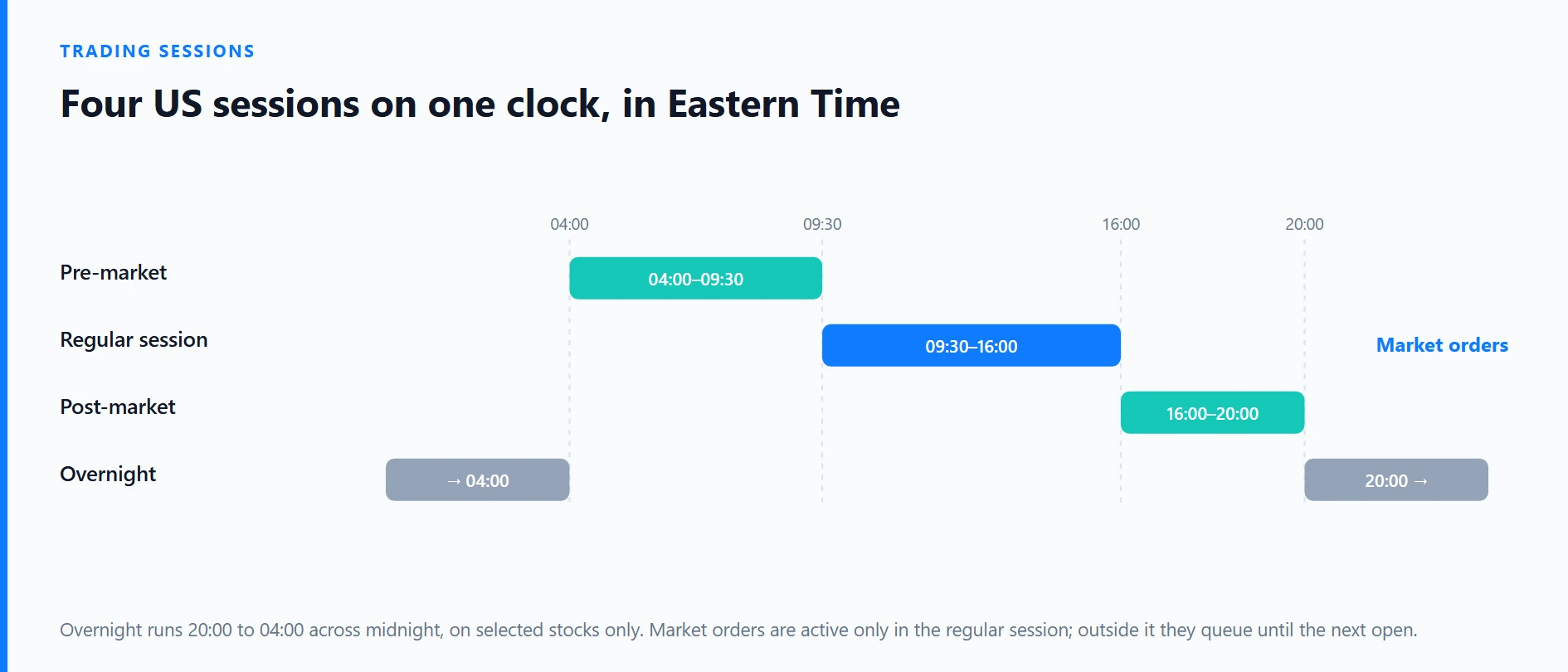
Last fact check: October 8, 2026. Binance Stocks can operate for up to 24 hours a day, five days a week, but “24/5” is not continuous 24/7 access and does not mean every ticker has the same sessions or liquidity. The order ticket and Session panel are the final operational reference for an eligible account.
Trading time affects more than convenience. It determines whether an order is active or queued, which participants and liquidity providers are present, how wide the spread may be and whether overnight news can create a gap before regular trading begins.
Table of contents
- Read the session map
- Convert Eastern Time
- Understand regular hours
- Use extended hours carefully
- Check overnight eligibility
- Match orders to sessions
- Check holidays and early closes
- Follow the order checklist
1. Read the session map
Binance's current Stocks guide defines three selectable session scopes:
| Scope | Included period in Eastern Time | Market-order behavior | Main caution |
|---|---|---|---|
| Regular Trading Hours | Market-Open, 9:30 AM–4:00 PM | Market and limit orders are active | Opening and closing can still be volatile |
| Extended Trading Hours | Pre-Market 4:00–9:30 AM + Market-Open + Post-Market 4:00–8:00 PM | Market orders queue until the next Market-Open | Wider spreads and partial fills are more likely |
| 24-Hour Trading | Overnight 8:00 PM–4:00 AM + all periods above | Only selected stocks support this scope | Overnight liquidity can be low |
“Extended” is a participation scope, not a promise that a particular order type executes in every segment. A displayed last price can come from an earlier session and is not a guaranteed execution price.
2. Convert Eastern Time with DST
US Eastern Time alternates between UTC−5 in standard time and UTC−4 during daylight saving time. NIST states that in 2026 daylight saving time runs from March 8 at 2:00 AM local time until November 1 at 2:00 AM local time. Many other countries change clocks on different dates or not at all.
| US session | ET | UTC while New York is on daylight time | UTC while New York is on standard time |
|---|---|---|---|
| Pre-market | 4:00–9:30 AM | 08:00–13:30 | 09:00–14:30 |
| Regular | 9:30 AM–4:00 PM | 13:30–20:00 | 14:30–21:00 |
| Post-market | 4:00–8:00 PM | 20:00–00:00 | 21:00–01:00 next day |
| Overnight | 8:00 PM–4:00 AM | 00:00–08:00 | 01:00–09:00 |
Use an IANA timezone such as America/New_York in a calendar rather than saving a fixed UTC offset. Then compare it with the Binance Session panel for the instrument and order date. Record both local time and ET in the trading journal when midnight changes the calendar date.
3. Regular Trading Hours
Regular Trading Hours run from 9:30 AM to 4:00 PM ET on a normal US market day. Binance states that both market and limit orders are active in this window. Broad market liquidity is often deepest here, but the open and close can concentrate volatility.
A market order prioritizes execution, not price. Suppose the prior close was 100 USD, material news arrives overnight and the best available asks at the open begin near 108 USD. A queued market buy can execute near the new market, not at the old close. The exact result depends on available liquidity and order size.
Check bid, ask, quote timestamp and visible depth. “Regular hours” does not remove spread, slippage, partial-fill or halt risk.
4. Pre-market and post-market
Pre-market runs from 4:00 to 9:30 AM ET and post-market from 4:00 to 8:00 PM ET within Binance's Extended Trading Hours scope. Earnings, guidance, analyst actions and macroeconomic data often arrive while the regular session is closed.
Fewer participants can mean:
- wider bid/ask spreads;
- smaller displayed size at each price;
- larger movement from a modest order;
- partial fills even after price touches the limit;
- temporary divergence from the next regular-session price.
Use a limit order when the maximum buy or minimum sell price matters. A limit controls the boundary but does not guarantee execution. Reassess order size if the spread itself consumes a material part of the planned return.
5. Overnight and 24-hour trading
The overnight period is 8:00 PM to 4:00 AM ET. Combined with pre-market, regular and post-market, it creates the selected-stock 24-hour weekday scope. It is instrument-specific: seeing 24-hour trading for one ticker does not prove it exists for another.
Overnight quotes may have low liquidity, wide spreads and higher sensitivity to a single participant. A price move can reverse when the primary market and more liquidity reopen. Check the Session badge, current quote time and any liquidity warning every time; do not reuse a screenshot from a different stock or date.
The product remains 24/5, excluding weekends and US public holidays. It is not comparable to a crypto spot market that normally runs continuously through weekends.
6. Match order type to session
Binance currently supports market and limit orders for Stocks. Market orders are active only during Regular Trading Hours. In an Extended scope, a submitted market order queues until the next Market-Open; queued status does not reserve the current price.
Limit orders can participate across the selected Extended or 24-hour scope. A DAY limit expires at the end of the relevant trading day if unfilled. A GTC limit can remain active for up to 90 days, but GTC is not available for fractional orders. Confirm the displayed expiry rather than calculating it manually.
Before leaving an order open, define:
- the selected session scope;
- the maximum acceptable price or minimum sale price;
- the expiry and review date;
- the response to earnings or material news;
- whether a partial fill is useful or should be cancelled;
- the maximum spread and position size.
For a fuller comparison, use the market-versus-limit order guide.
7. Check 2026 holidays and early closes
The exchange calendar is not identical to a general US federal-holiday list. The NYSE calendar lists these remaining 2026 closures and early closes:
- Thanksgiving Day: closed Thursday, November 26;
- the day after Thanksgiving, Friday, November 27: early close at 1:00 PM ET;
- Christmas Eve, Thursday, December 24: early close at 1:00 PM ET;
- Christmas Day: closed Friday, December 25.
If you are planning into the new year, the next closures are New Year's Day on Friday, January 1, 2027, Martin Luther King, Jr. Day on Monday, January 18, 2027, and Washington's Birthday on Monday, February 15, 2027.
Dates can be updated, and the treatment of an evening or overnight segment around a holiday can differ from a normal weekday. Check the official NYSE calendar and the live Binance Session panel before submitting. Do not assume a market order queued during a closure will execute at the displayed last price.
8. Session-aware order checklist
Before preview:
- confirm the ticker and that the product is Stocks, not bStocks or Futures;
- read the Session badge and instrument eligibility;
- convert ET for the exact date, including daylight saving time;
- check exchange holiday or early-close status;
- read bid, ask, timestamp and spread;
- review material news released since the prior regular close;
- choose market or limit and the intended scope;
- reduce size or stop when liquidity is too thin.
On the preview, verify ticker, Buy/Sell, whole or fractional quantity, market/limit, limit price, session, DAY/GTC, funding source, conversion rate, trade value and estimated costs. After submission, distinguish filled, partially filled, pending, queued, cancelled and rejected states.
If the order is queued, review it again before the opening bell. If partially filled, separate the executed quantity from the open remainder. Compare the final average fill and costs with the preview, then save the order ID and statement.
Official sources
- Binance Academy: What Is Binance Stocks Trading?
- NYSE: Holidays and Trading Hours
- NIST: Daylight Saving Time Rules
Reviewed on October 8, 2026. Verify the current session and exchange calendar before every order.