
Orders & Costs
Binance Fractional Shares, Dividends and Stock Splits
A practical guide to fractional Binance Stocks orders, beneficial ownership, dividends, splits, residuals and corporate-action records.
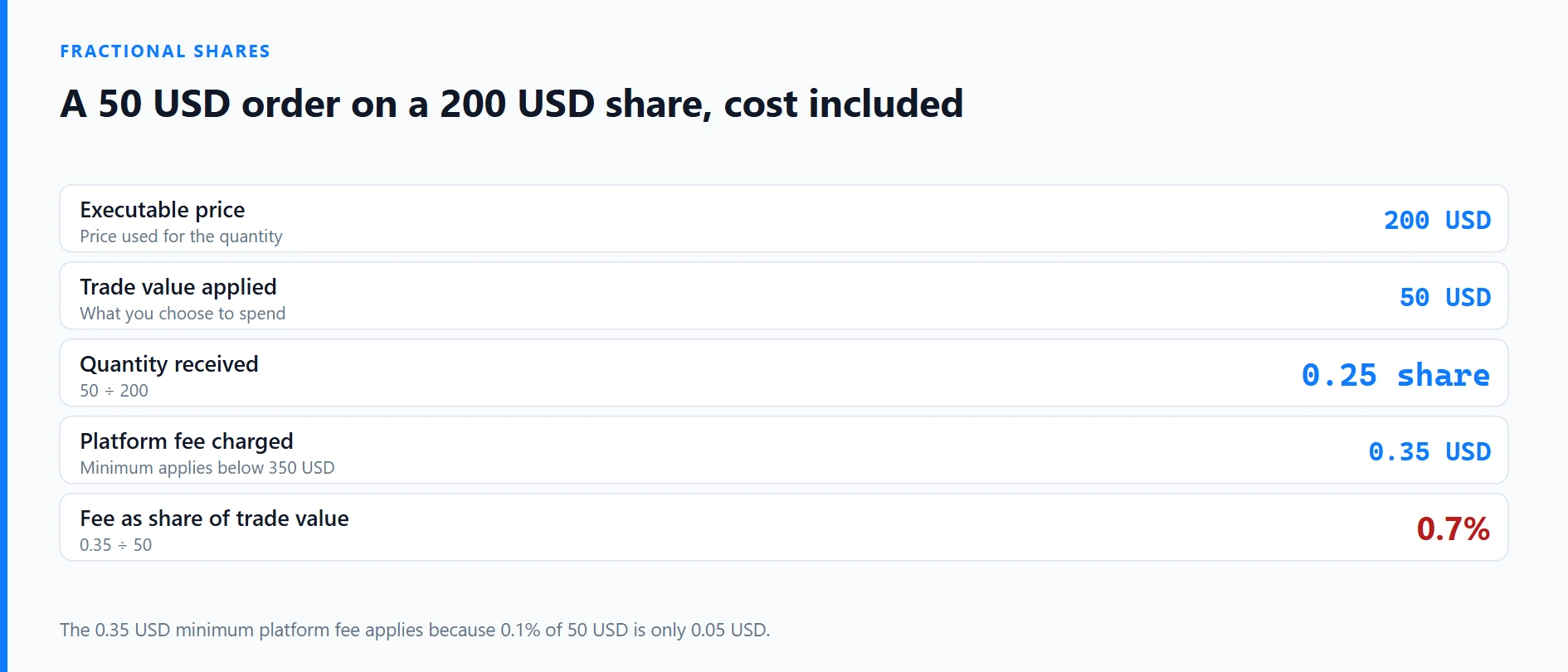
Last fact check: 8 October 2026. A fractional order lowers the cash needed to obtain stock exposure; it does not simplify ownership, fees, dividends or corporate actions. The preview shown here is useful because it separates the cash amount, estimated share quantity, trade value and fee before submission.
This guide concerns direct Binance Stocks Trading. It does not treat a bStock certificate or an equity perpetual as the same product. Access, instruments and account rights vary by jurisdiction and should be confirmed in the current customer agreement.
Contents
- Understand what the fraction represents
- Calculate the order and its effective cost
- Separate beneficial ownership from custody
- Follow the dividend timeline
- Check voting and transfer limits
- Reconcile splits and reverse splits
- Handle other corporate actions
- Watch very small residual positions
- Keep an event-level record
1. Understand what the fraction represents
A fractional share is less than one whole share. If 200 USD is the executable price and 50 USD is applied to trade value, the simple estimate is:
50 ÷ 200 = 0.25 share
The final quantity can differ because the quote moves, the order partially fills, currency is converted, or the platform applies supported decimal precision. Read the final average execution price and filled quantity instead of treating a preview estimate as a completed purchase.
Binance says fractional trading is available only for selected stocks. Its current Stocks guide also states that Good-Til-Cancelled orders can remain open for up to 90 days but are not available for fractional orders. Confirm the supported time in force on the live ticket.
2. Calculate the order and its effective cost
The current Binance Stocks guide states a 5 USD minimum investment. For a trade value of 350 USD or below, the guide states a minimum platform fee of 0.35 USD. Above 350 USD, the guide describes a 0.1% spread. The preview is the operative cost disclosure.
For a 50 USD example, 0.1% is 0.05 USD, so the 0.35 USD minimum applies. The direct platform cost relative to trade value is:
0.35 ÷ 50 = 0.7%
At the 5 USD product minimum, 0.35 ÷ 5 = 7% before conversion costs or market spread. This is why affordability is not the same as cost efficiency. Around the 350 USD boundary, a price or quantity change can move the order into a different stated fee treatment; refresh the preview rather than relying on mental arithmetic. The full Binance Stocks fee guide models more order sizes and round trips.
ADR fees, taxes, currency conversion and issuer-specific charges may also apply. Keep trade value, conversion, spread or platform fee, and any later account charge as separate fields.
3. Separate beneficial ownership from custody
Binance Academy describes Stocks Trading as a service provided by Nest Trading Limited with an external brokerage partner. The partner holds shares in custody, while the eligible user is described as the beneficial owner and may receive dividends and corporate-action benefits where applicable.
Beneficial ownership is not the same as appearing directly on the issuer’s shareholder register. Nor does it answer every operational question. Read the current agreement for custody, insolvency treatment, statements, complaint routes and rights passed through by the broker.
The product boundary matters:
| Product | What the user holds | Ordinary shareholder dividend? |
|---|---|---|
| Binance Stocks | Beneficial interest in a broker-custodied share | May apply under the custody and tax rules |
| bStocks | Tokenized certificate backed by an underlying share | Uses its own net-dividend Multiplier treatment |
| Equity perpetual | Leveraged derivative position | No ordinary shareholder dividend |
Do not infer rights from the ticker alone. The bStocks ownership and self-custody guide explains that separate certificate structure in detail.
4. Follow the dividend timeline
A dividend is a board-authorized distribution, not guaranteed yield. Four dates can matter:
- declaration date: the company announces the amount and schedule;
- ex-dividend date: buying on or after this date generally does not qualify for the next dividend;
- record date: the company identifies holders for the distribution;
- payment date: the issuer sends the payment into the custody chain.
Under the current US T+1 settlement environment, Investor.gov explains that the ex-dividend date is usually the record date, or the preceding business day when the record date is not a business day. Special dividends and unusual actions can follow different procedures, so use the issuer announcement and broker notice for the specific event.
Assume an eligible position is 0.25 share and the declared dividend is 0.50 USD per share. The gross arithmetic is 0.25 × 0.50 = 0.125 USD. Withholding, processing and rounding can reduce the net credit. Record the gross amount, tax withheld, any fee, net amount, currency and credit date separately. The platform credit can arrive after the issuer’s payment date. Use the currency, dividend and W-8BEN record checklist for the wider audit trail.
5. Check voting and transfer limits
Fractional-share programs are not identical across brokers. FINRA advises investors to ask how fractional orders are executed, whether after-hours trading is supported, how voting rights work and whether fractions can be transferred. A fraction may need to be sold or handled separately during an account transfer.
Do not assume Binance Stocks follows another broker’s policy. For this account, locate the current agreement or ask support:
- Can a fractional position receive or pass through voting instructions?
- Can whole shares and fractional remainders transfer to another broker?
- What happens to a fraction if the product or account closes?
- Which statement proves the user’s beneficial interest?
If the answer is not documented, record it as unknown rather than converting marketing language into a promised right.
6. Reconcile splits and reverse splits
A 2-for-1 split would ordinarily turn 0.40 share into 0.80 share while approximately halving the per-share reference price. A 1-for-10 reverse split would ordinarily turn 0.40 into 0.04. The mechanical event is not intended by itself to create or destroy total economic value, although the market price can move for other reasons.
Fractions introduce precision and residual questions. The broker may round to supported decimals, provide cash in lieu for an unsupported remainder, cancel open orders or pause processing. Do not overwrite the old record. Preserve the pre-event quantity, official ratio, effective date, post-event quantity, any cash credit and the first statement after processing.
If the arithmetic and the statement differ, first look for an unsupported remainder, cash in lieu, tax, fee or a position that was not eligible on the relevant date. Escalate an unexplained difference with the event notice and order records attached.
7. Handle other corporate actions
FINRA lists dividends, splits, reverse splits, mergers and rights offerings among common corporate actions. Tender offers, spin-offs, delistings and cash-or-stock elections can add deadlines or choices. A custody platform may support a choice, restrict it or apply a default when no instruction is received.
For every notice, identify:
- the legal action and affected share class;
- whether it is mandatory or voluntary;
- the record, election and effective dates, including time zone;
- the cash, share or other-asset ratio;
- treatment of fractional residuals;
- fees, withholding and cost-basis consequences;
- impact on open orders and transfers;
- the default if no action is taken.
Read notices promptly. A later market article may explain the event but cannot reopen a broker deadline.
8. Watch very small residual positions
The current Binance guide says a holding below 5 USD with no trading activity for 120 days may be sold for USDC, with a 0.01 USD fee. This is a product-specific low-balance rule, not leveraged margin liquidation. Review small residuals instead of assuming they can remain indefinitely.
Check whether a split, reverse split or partial sale pushed the position below the threshold. Keep contact details current and download statements before closing an account or leaving a jurisdiction.
9. Keep an event-level record
For each purchase, distribution or corporate action, preserve:
| Field | What to record |
|---|---|
| Position identity | Ticker, exchange, share class and whole/fractional quantity |
| Order evidence | Order ID, submitted value, average fill, filled quantity and time in force |
| Direct costs | Platform fee or spread, conversion, ADR fee and tax |
| Dividend evidence | Declaration, ex-date, record date, gross amount, withholding and net credit |
| Corporate action | Official notice, ratio, election deadline, before/after quantity and residual cash |
| Reconciliation | Statement date, discrepancy, support case and resolution |
A screenshot is helpful context; it does not replace downloadable statements, issuer notices or transaction history. Reconcile the first statement after an event with the final statement before it.
Official sources
- Binance Academy: What Is Binance Stocks Trading?
- FINRA: Investing in Fractional Shares
- FINRA: Corporate Actions by Public Companies
- Investor.gov: Ex-Dividend Dates
- FINRA: Stock Splits
Recheck the live product agreement, order preview and event notice before acting.