
Risk & Research
Binance Stocks Tax Records: Dividends and W-8BEN
Build an auditable record for crypto-funded stock purchases, US dividend withholding, bStocks Multiplier changes, sales and local-currency tax reporting.
Last fact check: October 8, 2026. This is a recordkeeping framework, not personal tax advice. Tax residence, account entity, product structure and the law in force on the transaction date can change the result. A qualified adviser must determine what is reportable and which costs are allowed in your jurisdiction.
A crypto-funded stock order can create more events than the final buy and sell. A user may acquire USDT or BNB with local currency, convert it to USDC at order submission, buy a fractional share, receive a dividend, experience a corporate action and later sell into USDC. Treating that entire chain as one transaction can leave gaps that are difficult to repair at filing time.
Table of contents
- Classify the product and event
- Map the full transaction chain
- Build local-currency cost records
- Check US dividend withholding
- Separate bStocks distributions
- Track sales and corporate actions
- Create an audit-ready ledger
- Reconcile the year
- Ask precise adviser questions
1. Classify the product and event
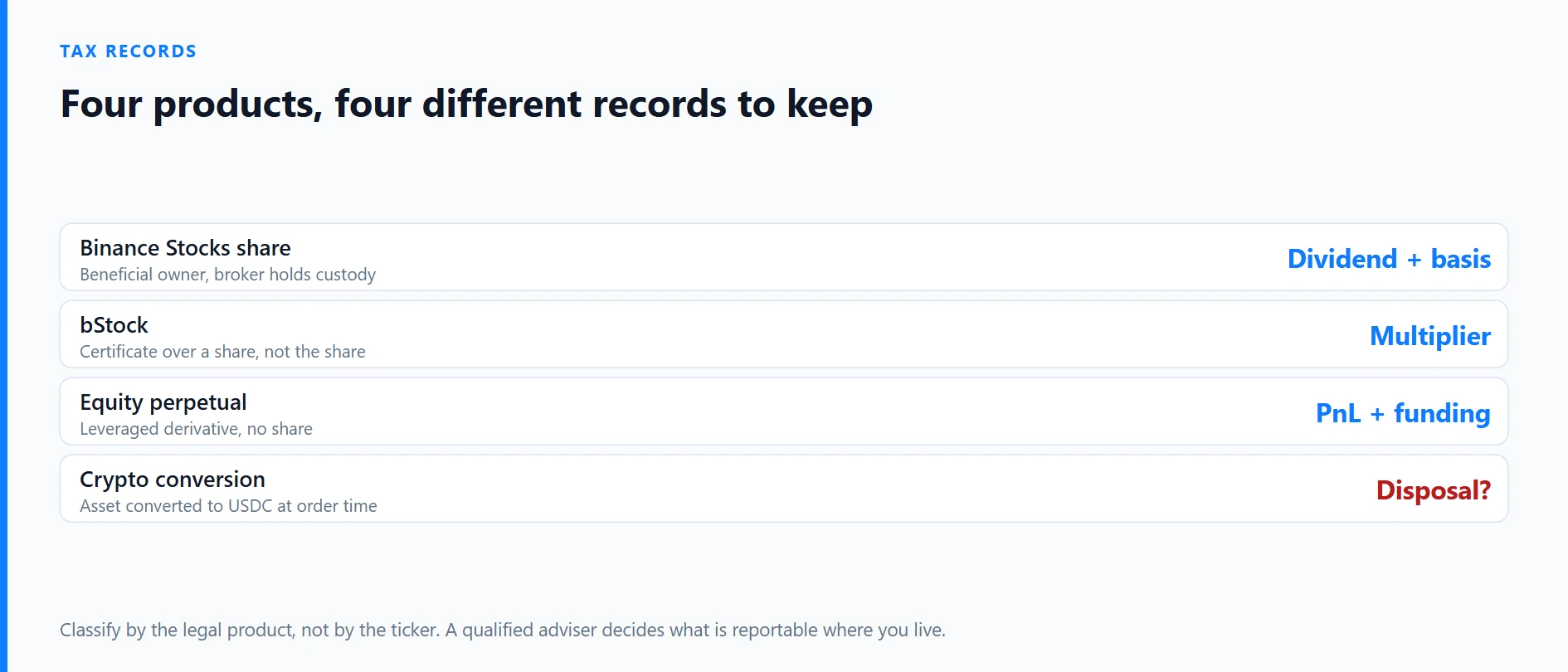
Start with the legal product rather than the ticker. Binance Stocks, bStocks and equity perpetual contracts can reference the same company while creating different rights, cash flows and records.
| Product or event | What the official product material says | Recordkeeping question |
|---|---|---|
| Binance Stocks share | The user is the beneficial owner; the brokerage partner holds the share in custody | Which entity issued the statement and how is ownership classified locally? |
| bStock | A BTech certificate backed by an underlying share, not direct ownership of that share | Is the certificate, token transfer or Multiplier change a separate local tax event? |
| Equity perpetual | A leveraged derivative with funding and liquidation risk, not a share | Are realized PnL and funding reported separately from securities income? |
| Crypto conversion | A supported asset is converted to USDC for a Stocks order | Does exchanging one crypto asset for another create a disposal locally? |
| Dividend or corporate action | Cash, reinvestment, quantity or basis may change | What was gross, withheld, net and credited, and on which date? |
Do not copy the tax treatment of an ordinary broker-held share onto a token certificate or derivative without analysis. Use the three-product comparison to identify the product before building the ledger.
2. Map the full transaction chain
Write the path before the first order. One example is:
local currency → USDT → USDC conversion at order submission → fractional share → USDC sale proceeds → local currency.
Each arrow can have its own timestamp, exchange rate, fee and transaction identifier. Some jurisdictions may treat a stablecoin-to-stablecoin exchange as a disposal even when both assets target one US dollar. Others may use different rules. The safe operational approach is to record the conversion separately and let the applicable law determine its treatment.
Binance currently states that Stocks purchases are primarily made in USDC and that supported assets such as BNB, USDT, U and USD1 can be converted at order submission. Any unused converted USDC is returned to the Funding Account, while sale proceeds are credited in USDC. Preserve the conversion preview and the final history; do not assume the original funding asset is restored.
3. Build local-currency cost records
The app may show USDC, but a return may require the functional or local currency. Record the permitted exchange-rate source, timestamp and timezone for every acquisition, fee, dividend and disposal. Confirm with an adviser whether the same-day official rate, transaction rate, daily average or another method is required.
For a purchase, retain:
- legal company name, ticker and share class;
- whole or fractional quantity;
- order and fill timestamps, including timezone;
- funding asset and quantity converted;
- conversion rate and USDC trade value;
- platform fee, spread and any other disclosed charge;
- local-currency value under the selected method;
- order, conversion and statement identifiers.
Suppose an order preview shows 200 USDC of trade value and a 0.35 USDC platform fee. The audit record should preserve both figures rather than silently combining them. Whether the fee increases basis, is separately deductible or receives another treatment is a legal question. A spreadsheet should show the raw amounts and a separate formula column, so a later rule correction does not overwrite the source data.
Screenshots help explain what the user saw, but downloadable statements, transaction history and issuer notices are better primary records. Export them regularly in case product access later changes.
4. Check US dividend withholding
For a nonresident alien receiving US-source dividends, the IRS states a general 30% withholding rate or a lower treaty rate where applicable. Form W-8BEN is used to establish foreign status and, when eligible, claim treaty benefits with the withholding agent. It is given to the requester, not sent directly to the IRS.
Whether a lower rate actually exists depends on the treaty between the United States and your country of residence, and not every treaty covers dividends. Some countries are covered only by the 1973 US–USSR convention, which has no dividends article at all; for a resident of one of those countries the 30% rate stands even with a correctly filed W-8BEN. Check your own country in the IRS treaty list before assuming a reduction, and ask the withholding agent which rate it will actually apply.
That general rule does not prove which rate a particular Binance account will receive. Ask the provider or adviser:
- which tax-residency form is accepted for this product and account entity;
- the gross dividend and payment date;
- the withholding rate, amount and jurisdiction;
- whether a treaty rate was actually applied;
- where and in which currency the net amount was credited;
- whether a year-end withholding statement is available.
Do not infer the withholding percentage from the net credit alone when ADR fees, conversion or other charges may also appear. Foreign withholding is also not automatically the final tax cost in the country of residence. A foreign-tax credit may require specific evidence and may be limited or unavailable.
5. Separate bStocks distributions
Binance describes a different mechanism for bStocks. The net dividend value is reinvested into the underlying share and reflected through an increase in the holder's bStock balance using the Multiplier. The guide says US withholding applies before reinvestment but does not state a rate, so use the IRS statutory rate above as the starting point rather than a figure quoted from the product page.
Availability has a separate offering boundary. The official guide says bStocks are offered through an ADGM-approved prospectus, do not constitute a public offer outside ADGM and may be used on the secondary market only by eligible users in permitted jurisdictions. A tax discussion does not confirm that the product is available, lawful or suitable for a particular account or country.
This is not the same cash-flow presentation as a cash dividend credited to an account. Keep:
- the issuer or platform notice;
- the record and effective dates;
- token quantity before and after the adjustment;
- the Multiplier before and after;
- gross value, withholding and net reinvested value if disclosed;
- the local-currency value and exchange-rate source;
- any on-chain transfer made before or after the event.
Local law may characterize a certificate balance increase differently from cash income. Do not call it tax-free merely because no cash arrived, and do not assume the Stocks treatment automatically applies.
6. Track sales and corporate actions
For every sale, retain gross proceeds, quantity, average fill, fees, conversion, local-currency proceeds and the acquisition lots used by the permitted basis method. If local rules allow losses to offset gains, documentation, matching rules and filing deadlines still matter.
Corporate actions require a continuous history:
- a split can change quantity and per-share basis without being an ordinary sale;
- cash in lieu of a fractional entitlement may create a separate cash event;
- a merger, spin-off or rights issue can require basis allocation;
- an ADR may charge a periodic depositary fee;
- Binance's low-balance rule may sell holdings below 5 USD after 120 days without trading activity and apply a 0.01 USD fee.
Keep the balance immediately before the event, the official notice, the applied ratio, any cash component and the balance immediately after it. The current position alone cannot reconstruct the history.
7. Create an audit-ready ledger
Use one row per economic event, not one row per company. Minimum fields include:
| Field group | Store this evidence |
|---|---|
| Identity | Account entity, product type, ticker or token contract, order ID |
| Time | UTC timestamp, local timestamp, timezone and settlement date |
| Quantity | Units before, change, units after and fractional precision |
| Currency | Asset given, asset received, platform rate and local-currency rate |
| Costs | Platform fee, spread, ADR fee, network fee and tax withheld |
| Income | Gross dividend, withholding, net credit or Multiplier adjustment |
| Evidence | CSV/PDF filename, statement period, notice URL and download date |
| Tax work | Unmodified raw value, proposed classification and adviser note |
Never replace the raw data with a tax-adjusted number. Keep calculation columns separate, document formulas and lock the original export. Hashing or versioning exported files can help show that the source record was not silently edited.
8. Reconcile the year before filing
At least quarterly—and again before filing—reconcile:
- opening and closing cash or crypto balances;
- every conversion into and out of USDC;
- purchases, sales, cancellations and partial fills;
- gross dividends, withholding and net credits;
- bStocks Multiplier and corporate-action changes;
- fees deducted from Funding or Spot;
- transfers to or from a self-custody wallet;
- platform totals against your own lot ledger.
Investigate rather than force a balancing entry. Common causes include timezone cutoffs, a conversion recorded separately from the stock order, partial fills, fees charged to another account and corporate actions posted on a different date.
9. Questions for a tax adviser
Bring the product terms and sample statements, then ask:
- How are stablecoin conversions classified in my residence country?
- Which local-currency rate and timestamp must I use?
- Is a Binance Stocks position treated as a foreign security or another interest?
- How is a bStock certificate and Multiplier increase classified?
- Can foreign dividend withholding be credited, and what document proves it?
- Which lot-matching method applies to fractional sales?
- How are platform fees, spreads and ADR charges treated?
- Do foreign-account, securities or crypto-asset reports apply?
- How long must each record be retained?
Official sources
- Binance Academy: What Is Binance Stocks Trading?
- Binance Academy: What Are bStocks?
- IRS: Instructions for Form W-8BEN
- IRS: US-source income paid to nonresident aliens
- IRS: United States income tax treaties A to Z
Reviewed on October 8, 2026. Verify current product documents and obtain jurisdiction-specific advice before filing or acting.