
Risk & Research
How to Research a Stock With SEC EDGAR
Use SEC EDGAR to verify the security, read 10-K, 10-Q and 8-K filings, test cash flow and debt, build valuation scenarios and write a one-page thesis.
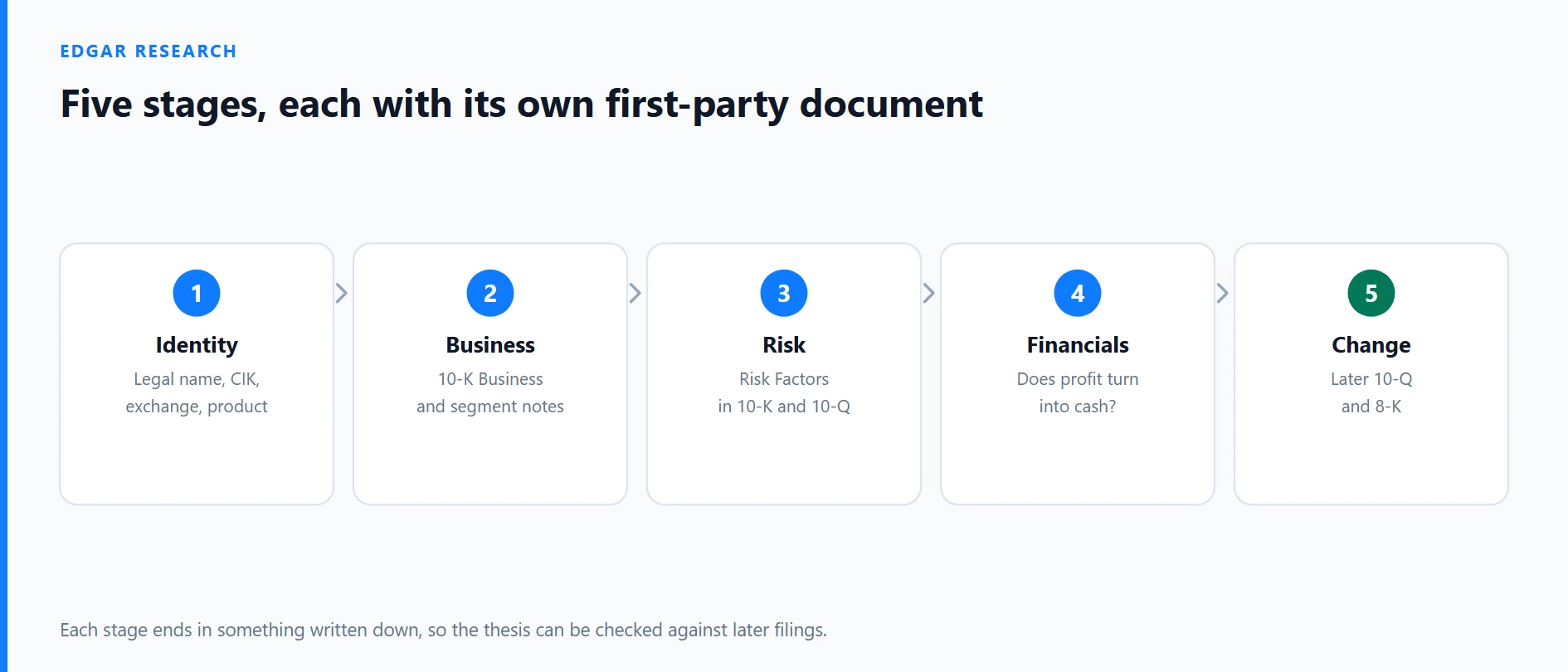
Last fact check: August 24, 2026. This workflow is designed primarily for US-reporting companies. Its purpose is not to produce a stock tip; it is to build a repeatable record of verified facts, explicit assumptions and conditions that would invalidate a decision.
Finding a ticker and opening a Binance order preview can take minutes. Understanding the company behind it requires more than a price chart. Binance is the execution venue for an eligible account; it does not decide whether the business is durable, cash generation is real or the current price requires unrealistic assumptions.
Table of contents
- Start with the research map
- Verify the company and product
- Read EDGAR in sequence
- Explain the business model
- Track five financial lines
- Read the balance sheet by sector
- Test management commentary
- Use valuation scenarios
- Write the counter-thesis
- Complete a one-page template
Research map
| Stage | Main question | First-party document | Written output |
|---|---|---|---|
| Identity | Is this the correct company and instrument? | Exchange profile, company IR page, SEC company page | Legal name, ticker, CIK, exchange, product type |
| Business | Where does the money come from? | 10-K Business section and segment notes | Revenue engine and largest cost |
| Risk | What could break the thesis? | 10-K/10-Q Risk Factors | Three company-specific risks |
| Financials | Does profit turn into cash? | Financial statements and cash-flow statement | Three-to-five-year trend |
| Change | What happened after the annual report? | Later 10-Q and 8-K filings | Dated change log |
| Price | Which assumptions does the market price require? | Current market value plus filing data | Weak, base and strong scenarios |
Save the filing links and retrieval date. A research note without source references becomes difficult to audit after the company updates guidance or files an amendment.
1. Verify the company and instrument first
Record the legal company name, ticker, listing exchange and SEC Central Index Key (CIK) together. The SEC search page accepts a company name, ticker or CIK. A similar ticker in another market can refer to a different issuer, share class or depositary receipt.
Confirm that the investor-relations filing link resolves to the same CIK shown in EDGAR. Check whether a filing has “/A” after its form type, which marks an amendment. An amended filing can change figures or disclosure that appeared in the original.
Then verify the product label on Binance. A brokerage-held share, ETF, ADR, bStock certificate and stock perpetual contract do not create the same rights or risks. If the screen shows Futures, leverage, funding or liquidation, it is not an ordinary share order. Use the Binance Stocks, bStocks and perpetuals comparison before researching the wrong instrument.
For an ETF, identify the fund, index, expense ratio, holdings, concentration and prospectus rather than analyzing it as one operating company. For an ADR, identify the depositary, underlying foreign issuer, ratio and applicable fees.
2. Read EDGAR filings in the right sequence
The SEC's research guide distinguishes three common reports for domestic public companies:
- 10-K: audited annual financial statements, the business description, material risk factors and management's discussion and analysis (MD&A);
- 10-Q: unaudited quarterly financial statements, updated risks and quarterly MD&A;
- 8-K: material current events or information disclosed before the next scheduled annual or quarterly report.
Open the latest 10-K first. Then read every later 10-Q and recent 8-K in chronological order. Using only the annual report can miss a new borrowing, acquisition, leadership change, guidance revision, impairment, legal event or control weakness.
Not every issuer uses these forms. The SEC notes that foreign private issuers may use 20-F for annual reporting and 6-K for reports connected with home-country disclosures or communications to security holders. Funds use different registration statements, prospectuses and shareholder reports. Match the form to the issuer type rather than treating a missing 10-Q as proof that no report exists.
Read the filing itself, not only the earnings presentation. A press release can summarize selected metrics; the filing contains accounting policies, footnotes, risk updates and legally filed exhibits.
3. Explain the business model in one paragraph
Do not merely list products. Describe the economic mechanism:
- Who is the customer, and why does that customer pay?
- Is revenue transactional, subscription, advertising, interest, licensing or another model?
- What determines price, volume and customer retention?
- Which cost is largest, and how does it change with scale?
- How concentrated is revenue by customer, product or geography?
- What technology, regulation or competitor could make the offer less valuable?
Use the Business section, segment note and customer-concentration disclosure. If the paragraph can be written only with promotional adjectives, the business has not yet been explained.
Separate recurring revenue from one-time sales and acquisitions. A company can report rapid headline growth while its existing customer base slows. Currency translation can also raise or lower reported growth without changing local demand.
4. Track five financial lines together
Collect at least three years, and preferably five when the business history allows:
- revenue and its growth rate;
- gross and operating margin;
- operating cash flow;
- capital expenditure and a clearly defined free-cash-flow measure;
- weighted-average diluted shares or another consistent dilution measure.
Definitions matter. “Free cash flow” is usually operating cash flow less capital expenditure, but companies can define adjusted versions differently. Write the formula used and reconcile management's non-GAAP metric with the GAAP cash-flow statement.
If earnings rise while operating cash flow weakens, inspect receivables, inventory, deferred revenue, payables and one-time items. Positive accounting profit with persistent cash outflow needs an explanation, not an automatic conclusion.
Track share count alongside earnings. Stock-based compensation, convertible securities and acquisitions can dilute the investor even when the expense is described as non-cash. Earnings can grow while earnings per share stagnates if the denominator grows quickly.
5. Read the balance sheet in the sector's language
Record cash, short-term investments, current liabilities, total debt, interest expense and the maturity schedule. The total debt figure alone does not show whether refinancing risk is near. Note fixed versus floating rates, secured debt, covenants and maturities within the next several years.
Ask whether the company could fund normal operations through a downturn without issuing equity at a distressed price. For an early-stage company, estimate the cash runway under a conservative burn rate; for a mature company, compare interest and maturities with recurring cash generation.
Use sector-specific measures. Deposits, capital ratios and credit quality matter for banks; reserves and underwriting for insurers; inventory and capital intensity for manufacturers; deferred revenue, retention and stock compensation for software companies. A ratio copied from another sector can be precise but irrelevant.
6. Compare management claims with results
Read management's explanation of revenue, margins, liquidity and known trends in MD&A. Compare the prior year's guidance and strategic promises with what actually occurred. Repeated “one-time” adjustments, definitions that change every quarter and selective emphasis on favorable metrics deserve additional scrutiny.
Review the auditor's opinion, related-party transactions, legal proceedings and material weaknesses in internal control. None automatically makes the stock uninvestable, but each should affect the risk case or valuation assumptions.
The proxy statement can add executive compensation, incentive targets, board information and related governance detail. Check whether management is rewarded for revenue growth alone, per-share value, cash generation or another target. Incentives help explain which metrics may receive the most attention.
7. Use valuation as a scenario range
No single ratio works for every business. P/E is not meaningful when earnings are negative or temporarily distorted. EV/EBITDA can ignore capital intensity and may be unsuitable for many financial companies. Price-to-sales can hide very different margins. Free-cash-flow yield depends on a consistent cash-flow definition.
Write three scenarios:
- Weak: revenue growth and margin fall below the base case;
- Base: the main operating assumptions are partly achieved;
- Strong: growth, margin or cash conversion exceeds the base case.
For each, show revenue, margin, share count and an appropriate valuation range. The goal is not a precise price prediction. It is to reveal how much optimism the current market value already requires and which variable matters most.
Compare with companies that share similar economics, not simply the same industry label. Normalize cyclically high or low margins and separate balance-sheet differences. A low multiple can reflect a deteriorating business; a high multiple can require years of strong execution.
8. Write the counter-thesis and invalidation rule
Try to disprove the investment case before submitting an order. “I will sell if the price drops” is not a business invalidation rule. Use measurable evidence, for example:
- market share in the core product declines for several periods;
- the gap between profit and operating cash flow keeps widening;
- a debt maturity or covenant materially weakens liquidity;
- a regulatory decision changes the revenue model;
- management misses a previously emphasized operating commitment;
- dilution exceeds the level assumed in the valuation.
Also write what evidence would strengthen the thesis, the maximum position size and the next scheduled review date. The beginner risk plan separates business research from portfolio-size control.
One-page research template
Complete these fields before opening the order ticket:
- company, ticker, CIK, exchange and Binance product type;
- one-sentence description of how the business earns money;
- three revenue or cash-flow drivers;
- three company-specific risks;
- three-to-five-year revenue, margin, cash flow, debt and share-count trend;
- weak, base and strong valuation assumptions;
- the strongest counter-thesis and one measurable invalidation rule;
- maximum position size and review date after the next report;
- direct links to every 10-K, 10-Q, 8-K, 20-F or 6-K used.
Only then inspect ticker, product label, share quantity, payment asset, session, time-in-force, conversion and total cost in the Binance preview. Good company research cannot repair an order for the wrong product or at an undefined maximum price. Use the broker and custody comparison for the account-level decision.