
Products Compared
Binance Stocks vs bStocks vs Stock Perpetuals
Compare Binance Stocks, bStocks and stock perpetuals by legal structure, custody, dividends, trading hours, costs, leverage and exit route.
Last fact check: August 24, 2026. Product access and specifications can change by account and jurisdiction. This comparison uses the current Binance product guides and tells you what to verify before relying on any feature.
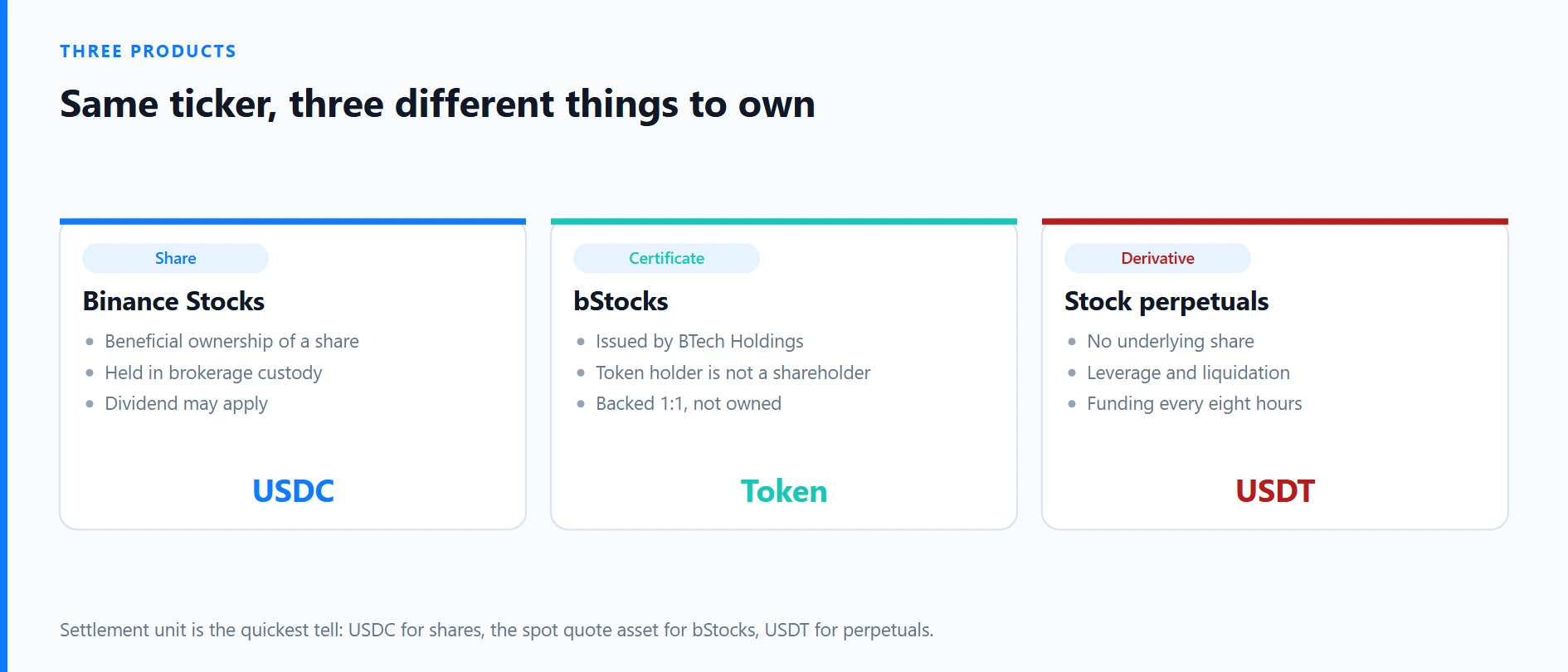
The same company name can appear in three different parts of Binance. Binance Stocks uses a brokerage custody model and describes the user as the beneficial owner of a purchased share. bStocks are tokenized certificates backed by underlying shares. Stock perpetuals are leveraged derivatives that provide price exposure without ownership. A familiar ticker does not make the rights or loss mechanisms equivalent.
This is a product-structure comparison, not a recommendation to buy a company. For the complete order flow, start with the US stock access walkthrough.
Table of contents
- Read the comparison matrix
- Understand Binance Stocks ownership
- Understand bStocks backing
- Understand perpetual leverage
- Compare exit routes
- Use the decision tree
Side-by-side comparison matrix
| Question | Binance Stocks | bStocks | Stock perpetuals |
|---|---|---|---|
| Legal/economic structure | Beneficial ownership of a share held through a brokerage chain | Tokenized certificate representing an interest in underlying securities | No-expiry derivative contract tracking an equity price |
| Named provider or issuer | Nest Trading Limited with an external brokerage partner | Issued by BTech Holdings Limited | Binance Futures TradFi perpetual contract |
| Registered holder of the underlying share | Brokerage/custody chain; user is described as beneficial owner | Token holder is not a shareholder of the listed company | No underlying share ownership |
| Dividend treatment | May be credited where applicable under custody and tax rules | Net dividend is reinvested; the Multiplier adjusts token balance | No ordinary shareholder dividend right |
| Settlement unit | Primarily USDC | Spot-market quote asset and token | USDT |
| Trading schedule | Regular, extended and selected 24-hour sessions; up to 24/5 | Binance Spot, generally 24/7 where available | 24/7 under contract rules |
| Withdrawal to a personal wallet | Not as an ordinary crypto token | Compatible BNB Smart Chain wallet for eligible users | No stock token to withdraw |
| Leverage | Not part of the ordinary cash-share order | Not part of an ordinary spot purchase | Up to the current contract tier; official guide states a present maximum of 10x |
| Periodic funding | No | No | Settled every eight hours under the current guide |
| Main additional risk | Broker, custody, jurisdiction, execution and currency | Issuer, custodian, smart contract, transfer, liquidity and offering boundary | Leverage, liquidation, funding, mark/index price and gap risk |
The matrix is a screening tool. The live terms, instrument page and order preview remain authoritative for an actual transaction.
1. Binance Stocks: what does beneficial ownership mean?
Binance’s Stocks Trading guide, updated June 4, 2026, says the service is provided by Nest Trading Limited in partnership with an external brokerage. Purchased shares remain in the brokerage partner’s custody, while the user is described as the beneficial owner and may be eligible for dividends and corporate actions where applicable.
Two limits matter. First, beneficial ownership is not the same as direct registration in your name on the company’s shareholder register. Second, convenient access through an exchange account does not automatically reproduce the asset-segregation, investor-compensation, transfer and complaint rules of a domestic broker. Read the client agreement that applies to your account.
Cost and execution
The current official guide describes a 0.35 USD platform fee for orders with trade value of 350 USD or below, and a 0.1% spread for orders above 350 USD. Periodic ADR fees of 0.01–0.03 USD per share may apply. Conversion, dividend, regulatory and tax costs can also exist. Treat these as changeable product specifications and confirm them on the order preview; the fee guide separates each cost layer.
Market orders are active only during regular US trading hours. Limit orders can participate in broader sessions depending on the selected instrument and session. This execution difference matters when comparing a cash share with continuously traded token or derivative markets.
2. bStocks: why 1:1 backing is not direct share ownership
Binance describes bStocks as tokenized securities issued by BTech Holdings Limited and classified as certificates representing certain financial instruments. Each token is stated to be backed 1:1 by a corresponding US share held with a regulated custodian, with backing viewable through Binance’s Proof of Collateral mechanism.
The token holder is not a registered shareholder of the listed company. The holder owns a certificate whose value and operation depend on the issuer, custodian, legal documents, token controls and trading market. “Backed 1:1” does not promise a zero spread, uninterrupted redemption, a fixed market price or the absence of issuer risk.
Corporate actions and self-custody
Under the current guide, cash dividends are not distributed directly. After applicable withholding, net value is reinvested in the underlying security and the token balance changes through the Multiplier mechanism. Splits can also adjust the balance. Corporate-action processing may temporarily pause deposits, withdrawals or conversion.
bStocks are BEP-20 tokens on BNB Smart Chain and may be withdrawn to a compatible wallet by eligible users. Self-custody removes one account dependency but adds address, network, smart-contract and wallet-security risk. The bStocks structure guide covers the Multiplier and withdrawal controls.
ADGM and country boundary
Binance’s current disclosure says bStocks are offered through an approved prospectus in ADGM and are not offered in other jurisdictions. No public offer is made outside ADGM; eligible users in permitted jurisdictions may access secondary-market trading. Do not infer personal eligibility from a public product page, another user’s screenshot or a VPN location.
3. Stock perpetuals: leveraged price exposure without ownership
A stock perpetual is a derivative with no expiry date. It does not deliver a share, dividend or voting right. Binance’s guide, updated April 23, 2026, describes USDT-settled contracts that trade 24/7, currently support maximum leverage of up to 10x, and settle funding every eight hours. Binance can change leverage tiers, margin requirements and other specifications.
When the underlying stock exchange closes for a weekend or holiday, the derivative can continue trading while the reference market cannot. Binance’s equity-perpetual pricing uses an orderbook EWMA approach intended to smooth low-liquidity transitions, but that design cannot remove price gaps, basis risk or liquidation. A correct long-term view of the company can still lose money if leverage, funding or mark-price movement closes the position first.
Read the stock perpetual mechanics guide before treating a TradFi Perp ticker as a share substitute.
Three products, three different exit routes
Product selection should start with the exit, not only the entry screen.
- Binance Stocks: sell the holding; the current guide says proceeds are credited in USDC to the Funding Account. Do not assume transfer to another broker unless current terms explicitly support it.
- bStocks: sell on Spot, convert an eligible bStock back to a corresponding share, or withdraw to BNB Smart Chain. Each route has separate liquidity, eligibility, network and operational conditions.
- Stock perpetual: close the derivative position; realized profit or loss settles in USDT. Liquidation can close it before the trader’s intended exit.
Also ask what records survive the exit: order confirmations, conversions, funding charges, dividend adjustments, tax withholding and on-chain transaction IDs belong in different ledgers.
Decision tree
- Do you want economic ownership and potential dividend rights? Compare Binance Stocks with a locally regulated broker.
- Do you specifically need a transferable BNB Smart Chain token? Review the bStock issuer, prospectus, collateral evidence and wallet risks.
- Is the goal short-term long/short price exposure rather than ownership? Budget perpetual leverage, liquidation and funding separately.
- Is the product absent from the verified account? Do not bypass the restriction; it is not available to that account.
- Are the legal entity, custody chain and exit route unclear? Do not place the order.
Four common classification errors
- Reading “1:1 backed” as direct company share ownership.
- Mistaking a company ticker in Futures/TradFi for an ordinary share.
- Reading 24/7 trading as equal liquidity and price quality at every hour.
- Treating a visible account feature as proof of local legal, tax or suitability status.