
Products Compared
Binance Stock Perpetuals vs Shares: Funding and Risks
Compare Binance stock perpetuals with share ownership across settlement, leverage, funding, 24/7 pricing, mark price, liquidation and exit records.
Last fact check: August 24, 2026. This guide reflects Binance's April 23, 2026 product guide and the equity-perpetual pricing change effective May 16, 2026. Contract specifications, leverage tiers and account availability can change, so the live order ticket remains the final check.
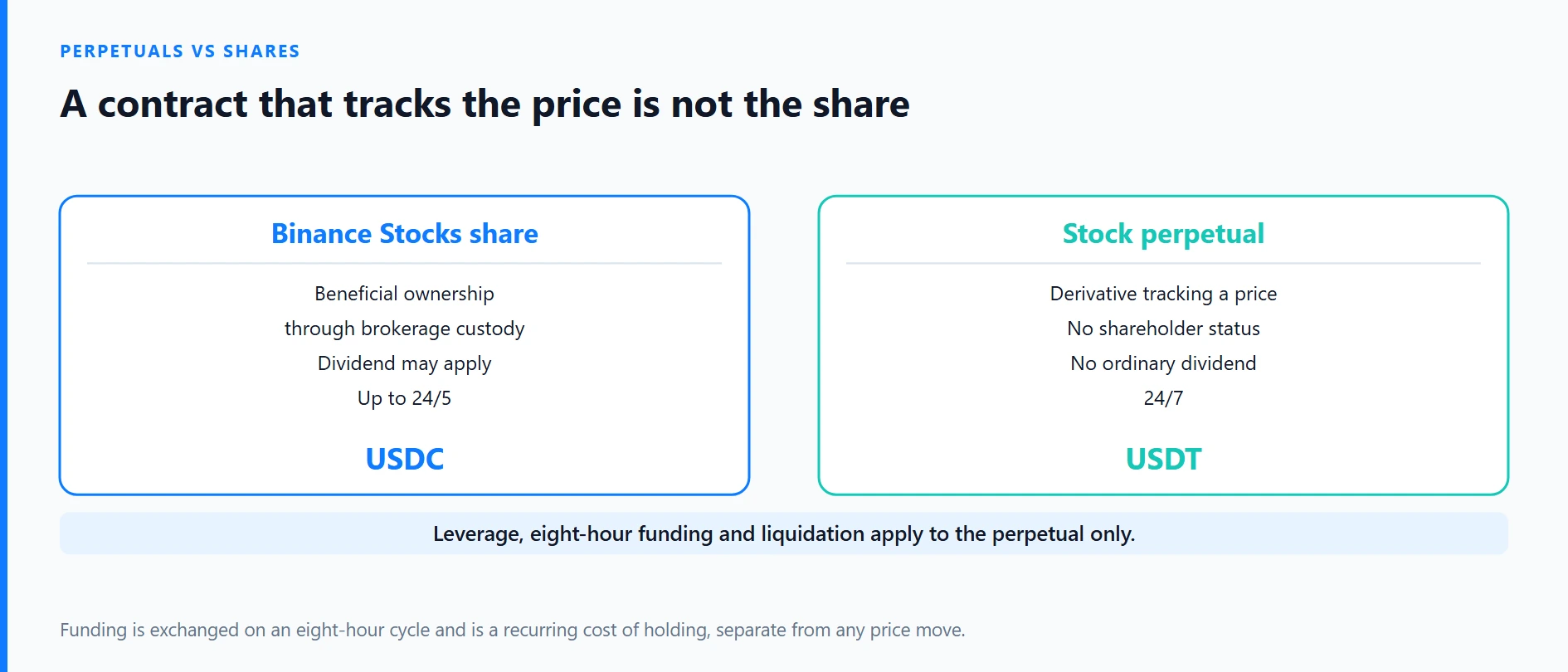
A stock perpetual contract follows the price of a listed company without expiring, but it does not give the trader that company's share. Opening an AMZNUSDT long position under Futures → TradFi is therefore not the same transaction as buying Amazon shares through Binance Stocks. It creates a USDT-settled derivative position whose result depends on contract pricing, leverage, funding and margin.
Table of contents
- Compare the two products
- Read the current contract terms
- Measure leverage and liquidation risk
- Calculate recurring funding
- Understand weekend and EWMA pricing
- Check last, index and mark price
- Use a pre-trade checklist
Shares and stock perpetuals at a glance
| Question | Binance Stocks share | Stock perpetual contract |
|---|---|---|
| What is held? | Beneficial ownership through brokerage custody | A derivative tracking a share price |
| Shareholder status | Depends on the brokerage and product terms | No direct shareholder status |
| Ordinary dividend rights | May apply under the share terms | No ordinary cash-dividend right |
| Settlement asset | Primarily USDC | USDT |
| Trading schedule | Up to 24/5 for eligible instruments | 24/7 |
| Leverage | Not part of an ordinary cash share order | Currently up to 10x |
| Recurring funding | None | Normally every eight hours |
| Forced liquidation | No leveraged-margin liquidation; a separate low-balance conversion rule can apply | Possible when margin is insufficient |
| Direction | Buy, hold and sell the share | Long or short the contract |
| Exit record | Share sale and USDC proceeds | Position close, realized PnL, fees and funding |
The familiar company ticker does not remove these structural differences. Binance's current Stocks guide also describes a separate low-balance rule: a holding below 5 USD with no stock transaction for 120 days may be liquidated into USDC with a 0.01 USD fee. That administrative conversion is not leveraged-margin liquidation, but it still matters when comparing how small residual positions can exit. For a wider comparison that also includes tokenized securities, read Binance Stocks vs bStocks vs stock perpetuals.
Current Binance stock perpetual structure
Binance's current guide describes stock perpetual contracts inside Futures → TradFi with these general settings:
- settlement and margin are denominated in USDT;
- trading is available 24/7, including when the underlying US exchange is closed;
- maximum leverage is currently 10x, subject to contract and risk-tier limits;
- the stated minimum notional is 5 USDT;
- the stated tick size is 0.01 and the minimum order amount is 0.01 units of the underlying share;
- Multi-Assets Mode is supported, with a haircut when eligible assets such as BTC are used as collateral.
Those platform-wide descriptions are not a substitute for the selected contract's specification. Before every order, inspect the ticker, minimum and maximum quantity, price increment, position tier, initial margin, maintenance margin and supported order types. A visible “10x” control is a ceiling, not a recommendation.
Account access is also separate from the product description. A public Binance page does not prove that a contract is offered in every country or enabled for every verified account. Do not use false residency, another person's identity or a VPN to bypass a restriction.
How leverage magnifies margin risk
Leverage controls notional exposure relative to posted margin. A simplified relationship is:
Notional exposure = margin × leverage
If a trader posts 200 USDT and selects 5x, the notional exposure is approximately 1,000 USDT. A 2% adverse move in the reference exposure would be about 20 USDT before trading fees and funding—roughly 10% of the initial 200 USDT margin.
That example does not calculate the liquidation price. Actual liquidation depends on maintenance margin, the position tier, wallet balance, cross or isolated mode, fees, other positions and the mark-price mechanism. The liquidation price shown by the interface should be rechecked whenever order size, leverage or available margin changes.
Cross margin can allow other eligible balance to support a position, but it can also expose more of the futures wallet to one losing trade. Isolated margin limits allocated collateral more clearly, yet the isolated position can still be liquidated. Neither mode turns a leveraged derivative into a cash share.
Write a maximum acceptable loss before placing the order. A stop order can reduce exposure when triggered, but it cannot guarantee a fill at the selected price during a gap or thin order book. Position sizing remains the primary control; see the beginner risk plan for a separate risk-budget workflow.
How eight-hour funding works
Funding is a periodic payment between long and short holders intended to keep the contract near its reference market. Binance's current stock-perpetual guide states that funding is calculated every eight hours, the interest component is 0%, and the rate is capped at ±2.00% per interval. It also states that the interval does not shorten to one hour when the cap is reached for these contracts.
A simplified estimate is:
Funding payment = position notional × funding rate
At 1,000 USDT notional and a 0.01% rate, one interval is 0.10 USDT. Whether the long or short side pays depends on the sign shown in the live contract. If a position is not open at the funding timestamp, that interval may not apply. Never copy yesterday's rate into a holding-cost estimate: check the current rate, the next funding time and the planned number of intervals.
Funding can turn a correct directional view into a poor net result when a position is held for many intervals. Keep it separate from execution fees and realized PnL in the trade journal. A closed-position export should record opening and closing fills, fees, each funding entry and the final realized PnL rather than only the headline price move.
Why the contract can diverge from the share
US equities form prices across pre-market, regular, after-hours and selected overnight sessions, broadly approaching a 24/5 schedule. The main exchange still closes for weekends and market holidays, while the perpetual contract continues trading 24/7. Company news, macro events or shallow weekend liquidity can therefore move the contract away from the most recent conventional share quote.
Binance says equity TradFi Perps moved to an Orderbook EWMA index-price method effective May 16, 2026. Under that method, an Impact Mid Price is derived from the contract order book and smoothed with an exponentially weighted moving average instead of relying on an external price vendor. The stated aim is smoother behavior during low-liquidity periods.
Smoothing does not remove basis risk, weekend gaps, slippage or liquidation. When the underlying market reopens, new share-market information can be incorporated quickly and the relationship between the two prices can change. Treat 24/7 access as a schedule, not as proof of continuous institutional liquidity.
Last price, index price and mark price
- Last price is the price of the latest executed contract trade.
- Index price is the contract's reference-price mechanism; under the current equity-perpetual method it is derived from order-book inputs and EWMA smoothing.
- Mark price is the fair-price mechanism used for unrealized PnL and liquidation calculations.
All three can differ at the same moment. Watching only the candle chart's last trade can hide the mark price that actually affects liquidation. Before opening a position, identify which trigger price a stop order uses and which price the liquidation estimate uses.
Checklist before opening a position
- Confirm the page says Futures → TradFi and the ticker is a USDT perpetual, not a share or bStock.
- Check long or short direction, order type, quantity, notional value and reduce-only settings.
- Read the selected leverage, initial margin, maintenance margin and displayed liquidation price.
- Understand whether cross or isolated margin can affect the rest of the futures balance.
- Compare last, index and mark price before confirming.
- Check the current funding rate, next timestamp and intended holding period.
- Confirm whether the underlying US share market is open, closed or on holiday.
- Inspect order-book depth and spread, especially outside the underlying market's active session.
- Set the position size, exit condition and maximum acceptable loss in advance.
- After closing, export fills, fees, funding and realized PnL for the record.
This is not a shortcut to share ownership
A perpetual can provide short exposure or a tactical leveraged position, but it does not replace long-term ownership of a dividend-paying share. If a trader cannot explain margin, funding, mark price and liquidation in plain language, recognizing the company name is not enough preparation.
For the unleveraged route, use the step-by-step Binance Stocks guide and confirm the product label before submitting anything.