
Risk & Research
Beginner Stock Trading Risk Plan: Practical Checklist
Build a one-page risk plan for emergency cash, platform exposure, position sizing, diversification, order execution, leverage and incident response.
Last fact check: August 24, 2026. A risk plan does not predict the market. It limits the damage that one bad decision can cause to your daily finances, portfolio and decision-making process.
Investor.gov describes asset allocation as dividing investments among categories such as stocks, bonds and cash, and diversification as spreading money among investments to reduce risk. Neither idea means simply collecting more tickers. Holdings can share the same sector, currency, platform or custody chain and still fail under the same shock.
Table of contents
- Write the eight-line plan
- Set goals and platform limits
- Calculate position size
- Separate product risks
- Define execution and leverage rules
- Prepare an incident plan
- Run a monthly review
The eight-line one-page plan
| Field | Rule to write before the order |
|---|---|
| Goal | What is the money for, and when will it be needed? |
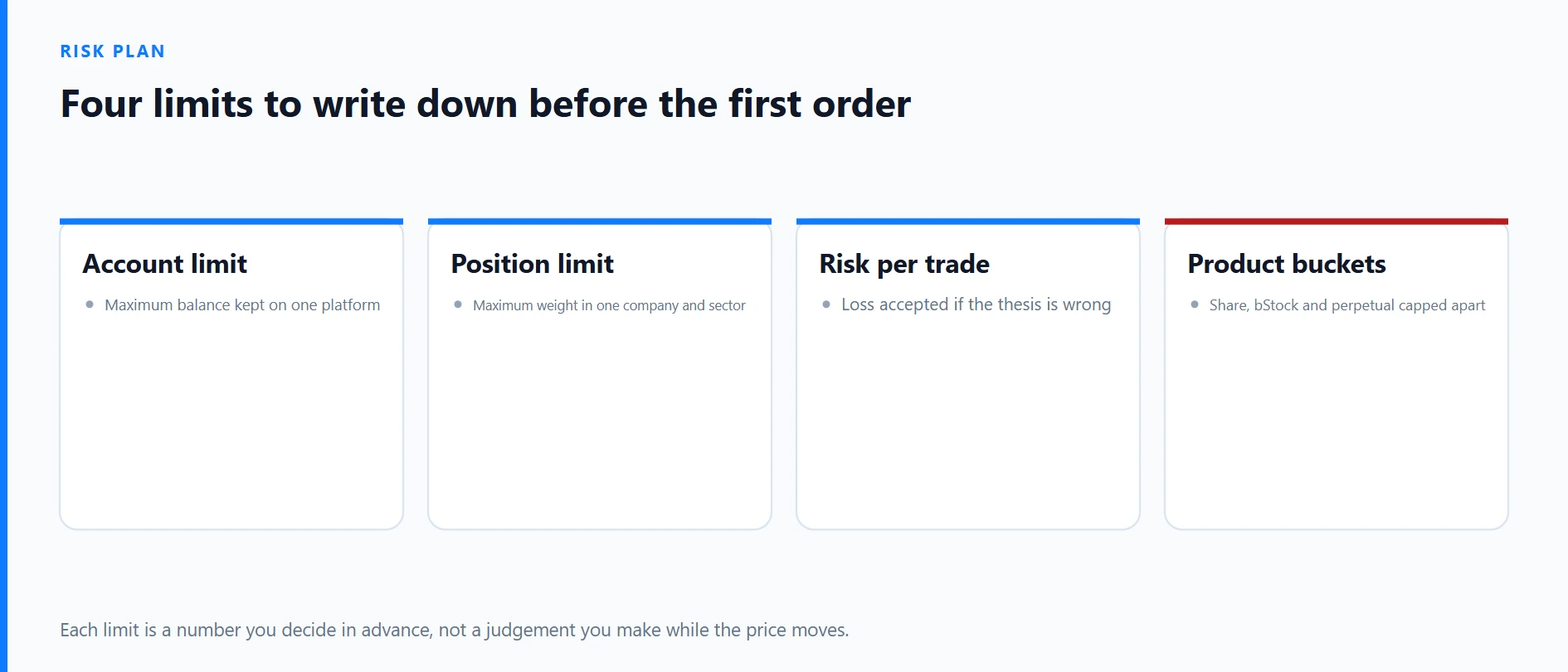
| Account limit | What is the maximum balance allowed on this platform? |
| Position limit | What is the maximum percentage in one company and sector? |
| Trade risk | What loss is tolerable if the thesis is wrong? |
| Product | How are a share, bStock and perpetual limited separately? |
| Order | Which order type is allowed in each session? |
| Stop condition | Which event pauses all new orders? |
| Review | On what date and evidence will the plan be updated? |
A table without numbers is only a list of intentions. Add percentages and currency limits based on your own finances rather than copying a stranger’s model allocation.
1. Start with the goal and time horizon
Rent, debt payments, tax money, education costs, medical expenses and cash needed soon do not belong in a volatile stock account. Write the investment goal, expected date of use and consequence if the goal must be delayed. A short time horizon leaves less room to wait through a price decline.
Keep an emergency reserve outside the trading platform. Investor.gov frames risk tolerance as both the willingness and ability to lose some or all of an investment in exchange for potential return. Emotional willingness is not financial capacity: you may feel calm about a loss while still needing the money next month.
2. Separate the platform limit from the portfolio limit
If your stock portfolio is worth $10,000, it does not have to sit in one account. Write a separate maximum for Binance or any other platform. This limit covers account compromise, product withdrawal, regional changes, the broker/custodian chain and temporary access problems in addition to market risk.
Track three figures:
- the maximum value of all investment assets;
- the maximum balance on this specific platform;
- the uninvested USDC or crypto balance held ready for orders.
Review the percentage after large gains. Platform concentration can rise without a new deposit.
3. Calculate position size from a loss budget
“I like the company” is not a position-sizing method. Define both the maximum portfolio percentage in one company and the maximum currency loss if the thesis fails.
Illustration only: a $5,000 account with a 1% per-trade risk budget allows a planned loss of $50. If evidence would invalidate the thesis at a price 10% below entry, the theoretical position is $50 ÷ 0.10 = $500. This is not a recommendation or a guaranteed stop. Price gaps, spreads, fees and failed execution can make the actual loss larger.
Set the invalidation point from the business thesis and market liquidity, not only from the percentage you would prefer to lose. Then reduce the position until the estimated loss fits the written budget. For a speculative company, test the plan against a near-total loss.
4. Diversify by source of risk
Five technology tickers may all depend on the same interest-rate environment, advertising cycle and US dollar. Add columns for company, sector, revenue geography, currency, product type, platform and custodian. Concentration becomes clearer when you map the common risk rather than count names.
Investor.gov describes rebalancing as returning a portfolio that has drifted to its intended allocation. Choose a calendar or predefined threshold instead of reacting to every price move. Check tax and transaction costs before acting. A broad fund may diversify company-specific risk better than a hand-picked list, but it introduces its own fees, index methodology and tracking risks.
5. Do not put three products in one risk bucket
- Binance Stocks: equity-market, legal-entity, broker-custody and regional-eligibility risks.
- bStocks: adds certificate issuer, custodian, smart-contract, network-transfer and offering-boundary risks.
- Stock perpetuals: adds leverage, funding, mark/index price and liquidation mechanics.
A familiar ticker does not make these products equivalent. Use the product comparison table and label every journal entry “Stock,” “bStock,” or “Perpetual.” If you cannot explain the ownership right and maximum-loss path, the permitted allocation to that product should be zero.
6. Create hard order and session rules
A market order prioritizes execution but does not guarantee price. A limit order controls the worst acceptable price but may remain unfilled. Liquidity can be thinner and spreads wider in extended or overnight sessions.
A beginner’s written rules might say:
- no market orders in the first 15 minutes of the main session;
- cancel the decision when the spread exceeds a preset threshold;
- no new position immediately before company results or major news;
- reject a preview when ticker, product, session or total cost does not match the plan;
- review partial fills and any open remainder before submitting another order.
The market-versus-limit guide explains DAY, GTC and session differences. The numbers in your rule must come from your circumstances and the instrument’s liquidity, not from this example.
7. Set a beginner leverage rule
The SEC’s investor education material warns that leverage magnifies losses quickly and, in some structures, can produce losses beyond the initial investment. Binance stock perpetuals add leverage, periodic funding and liquidation rules that do not exist in an ordinary unleveraged share purchase.
The simplest beginner rule is: use no leverage until you can independently calculate the mechanics and maximum loss. If a perpetual is ever permitted, write the maximum leverage, margin mode, notional exposure, liquidation price, funding budget and daily loss limit before opening it. Do not add margin to a losing position outside the plan.
8. Write a stop and incident plan
Pause all new orders if any of these occurs:
- an unknown login, device or withdrawal notice;
- a change in product terms or regional availability;
- inability to export transaction history or withdraw normally;
- two consecutive breaches of the written plan;
- an urge to increase size immediately to recover a loss;
- sleep loss, panic or the need to hide the decision from someone affected by it.
When account security may be compromised, follow the account security checklist before managing market exposure. An account incident and an investment loss require different responses.
Monthly review template
Record process as well as return:
- How many orders followed every written rule?
- What were the total fees, spread and conversion costs?
- What are the largest company, sector and platform weights?
- Which thesis changed after a filing or earnings report?
- Were security settings, devices and withdrawal addresses reviewed?
- What single behavior will be corrected next month?
A sound risk plan cannot guarantee profit. It can reduce platform dependence, cap planned exposure and make emotional decisions easier to detect before they compound.