
Risk & Research
Share Dilution and Buybacks: What Existing Investors Should Check
How to measure whether a company is diluting you or genuinely shrinking its share count: gross vs net buybacks, the real cash cost per share retired, the Item 5 repurchase table and the RSU overhang, worked through with Apple’s fiscal 2025 10-K.

A company can announce a $100 billion buyback and still leave your slice of the business almost unchanged, because it is quietly issuing new shares to employees at the same time. The opposite also happens: a stock offering looks alarming in a headline, but if the cash is spent well, existing holders can end up better off. What decides the outcome is not the press release but three numbers in the annual report: how many shares existed at the start of the year, how many at the end, and what the company paid to get from one to the other.
This guide shows where to find those numbers and how to judge them, using Apple's fiscal 2025 Form 10-K (year ended September 27, 2025; figures checked on October 6, 2026).
Dilution and buybacks in one sentence each
- Dilution happens when the share count rises. Each existing share then represents a smaller fraction of the company's earnings, cash flow and votes.
- A buyback (share repurchase) is the company spending its own cash to buy shares and retire them or hold them in treasury. The share count falls, so each remaining share represents a larger fraction.
A quick example of the arithmetic. A company has 100 million shares and you own 1 million, which is 1%. It sells 10 million new shares. You still own 1 million, but now out of 110 million: your stake drops to 0.909%. Whether that hurts depends on what the company does with the money raised. If the new cash earns nothing, earnings per share fall by the same 9.1%. If it funds a project that grows profits by more than 10%, you come out ahead despite the smaller percentage.
A stock split is not dilution. A 4-for-1 split gives you four shares for every one you held, and your percentage of the company stays the same. Splits only change the per-share price and the share count proportionally; our guide to fractional shares, dividends and stock splits covers how splits are handled in practice.
Where dilution actually comes from
New shares enter the count through a handful of routes. Each one leaves a trace in a different part of the filings:
| Source | Where to look | What to check |
|---|---|---|
| Stock-based pay (RSUs, options) | Share-based compensation note; statement of shareholders' equity | Shares issued each year, unvested awards still outstanding |
| Secondary offerings | Financing section of the cash flow statement; 8-K or prospectus filings | Price per share versus the current market price |
| Convertible bonds and preferred stock | Debt note; diluted EPS reconciliation | Conversion price and how many shares could be created |
| Warrants | Equity note | Exercise price, expiry date |
| Shares used to pay for acquisitions | Business combinations note | Shares issued versus the value acquired |
For large, profitable companies, stock-based compensation is usually the main source. For younger companies that burn cash, repeated offerings and convertibles tend to matter more. If you are not yet comfortable navigating these sections, start with our walk-through on how to read a 10-K without missing red flags.
Worked example: Apple's share count in fiscal 2025
Note 10 of Apple’s 10-K reconciles the share count for the year (the table shown at the top of this page). In millions of shares:
- Start of year: 15,116.8
- Repurchased: −401.7
- Issued to employees, net of shares withheld for taxes: +58.1
- End of year: 14,773.3
Gross reduction: 401.7 ÷ 15,116.8 = 2.66%. Net reduction: (401.7 − 58.1) ÷ 15,116.8 = 2.27%.
So about one in seven repurchased shares (58.1 ÷ 401.7 ≈ 14.5%) was needed simply to offset shares handed to employees. A holder with the same number of shares at both ends of the year owned 15,116.8 ÷ 14,773.3 = 1.023 times the percentage of the company they started with, an increase of about 2.3%, not the 2.7% the gross repurchase figure implies.
What the share reduction did to earnings per share
From the income statement, diluted weighted-average shares fell from 15,408.1 million in fiscal 2024 to 15,004.7 million in fiscal 2025, a drop of 2.62%. Over the same period:
- Net income rose from $93,736 million to $112,010 million: +19.5%
- Diluted EPS rose from $6.08 to $7.46: +22.7%
Dividing one growth factor by the other (1.227 ÷ 1.195 ≈ 1.027) shows that roughly 2.7 percentage points of the EPS growth came from the smaller share count rather than from higher profit. Neither part is "fake", but they are different things. When a company's EPS grows much faster than its net income for several years, the gap is being financed by buybacks, and you should ask whether that cash could have been used better.
What the buyback really cost
The headline number is the repurchase: Apple says it bought 402 million shares for $89.3 billion during fiscal 2025, an average of about $222 per share. The cash flow statement shows $90,711 million paid for repurchases in the year (timing of settlement explains the small difference).
There is a second, less visible payment. When employees' RSUs vest, Apple withholds some of the shares to cover their taxes and pays that tax in cash. The financing section lists "payments for taxes related to net share settlement of equity awards" of $5,960 million. Economically this is also money spent to keep the share count down.
Put together:
- Cash spent: $90,711m + $5,960m = $96,671 million
- Net shares retired: 343.5 million
- Cash per net share retired: about $281, compared with an average repurchase price of about $222
That $281 figure is the honest one to use when you ask how much it costs the company to shrink its share count, because part of every year's buyback only cancels out employee issuance. The income statement treats stock pay as an expense ($12,863 million of share-based compensation in fiscal 2025), but many "adjusted" metrics add it back. If you are comparing free cash flow with buybacks, our article on cash flow versus profit explains why stock pay can make operating cash flow look larger than the cash owners actually keep.
Reading the quarterly repurchase table
Item 5 of every 10-K (and Part II, Item 2 of each 10-Q) must include a table of shares the company repurchased in the last quarter, month by month. This requirement comes from Item 703 of SEC Regulation S-K. Apple's version for the fourth quarter of fiscal 2025:
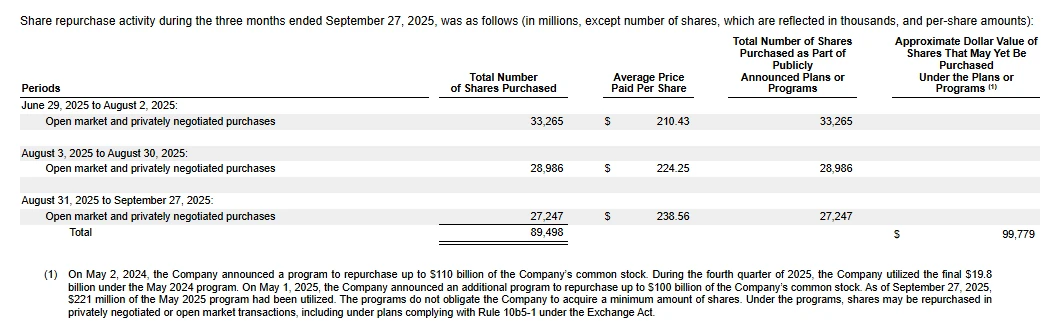
What this table tells you:
- Price discipline. Apple bought fewer shares each month as the average price rose from $210.43 to $238.56. That is consistent with spending a roughly fixed dollar amount, not with buying more when the price is low. Programs run under Rule 10b5-1 plans often work this way.
- Remaining authorization. The footnote shows a $100 billion program announced on May 1, 2025, of which only $221 million had been used by year end, leaving about $99.8 billion. An authorization is permission, not an obligation: the footnote states the programs "do not obligate the Company to acquire a minimum amount of shares."
- Pace versus authorization. Compare the remaining amount with the last full year's spending (about $90 billion). A company that announces large authorizations but spends a fraction of them is signaling more than it is buying.
The overhang: dilution that has not happened yet
Diluted EPS already counts some awards that are likely to become shares. Apple's EPS note adds 56.2 million "dilutive share-based awards" to the 14,948.5 million basic weighted-average shares.
The share-based compensation note shows the bigger pipeline: 151.6 million unvested RSUs at year end, about 1.0% of the outstanding shares, plus $21.8 billion of unrecognized compensation cost to be expensed over a weighted-average 2.5 years. Those RSUs will turn into shares as they vest, and the company will need to buy back roughly that many again just to keep the count flat.
For companies with convertible bonds, look for the number of shares that would be issued on conversion and the conversion price. If the stock trades above the conversion price, assume those shares will exist.
The 1% U.S. excise tax on buybacks
Since 2023, U.S. corporations listed on an established securities market pay an excise tax under section 4501 of the Internal Revenue Code. The statute sets it at 1% of the fair market value of stock repurchased during the taxable year, reduced by the fair market value of stock issued during the year, including stock issued to employees. Companies whose repurchases total $1 million or less in a year are exempt. The tax is small relative to the buyback itself, but it is a real cost that comes out of shareholders' money, and it makes net repurchases slightly more expensive than the per-share price suggests.
A checklist for any stock you own
Run these steps with the latest 10-K. The first four take about ten minutes.
- Net share change. Find the share reconciliation (equity note or statement of shareholders' equity). Calculate (ending − beginning) ÷ beginning. A positive number means you are being diluted.
- Five-year trend. Pull the diluted weighted-average share count from the income statement in older 10-Ks. One bad year can be an acquisition; a steady 2–4% annual increase is a habit.
- Gross versus net. Divide shares issued by shares repurchased. If more than half of the buyback is offsetting issuance, the buyback mostly funds employee pay.
- Real cost per net share. Add repurchases and net-share-settlement tax payments from the cash flow statement, then divide by net shares retired.
- Funding source. Compare buybacks plus dividends with free cash flow. Buybacks funded by new debt year after year raise risk even if EPS rises.
- Price paid. Check the monthly averages in the Item 5 table against the stock's valuation at that time. Buying heavily at very high multiples can destroy value.
- Overhang. Note unvested awards, options and convertible shares as a percentage of shares outstanding.
Common mistakes
- Reading the authorization as spending. "$100 billion buyback" is the ceiling of a program with no deadline, not money already spent.
- Using the gross repurchase count. It overstates how much your ownership grew whenever the company issues shares to staff.
- Calling a buyback good by default. Retiring shares at an inflated price transfers value from remaining holders to the sellers.
- Treating every offering as bad. Raising equity to fund growth at a fair price, or to avoid a dangerous debt load, can protect existing owners.
- Ignoring the timing of weighted averages. EPS uses the average share count over the year, so a big buyback late in the year affects next year's EPS more than this year's.
Limits of this analysis
The share count tells you about your percentage of ownership, not about whether the company is worth its price. A shrinking share count with falling profits is still a shrinking business. Figures above are from one fiscal year of one company and will change with the next filing; always pull the current 10-K and 10-Q from SEC EDGAR before relying on them.
Sources (checked October 6, 2026): Apple Inc. Form 10-K for the fiscal year ended September 27, 2025 (Item 5; Consolidated Statements of Operations, Shareholders' Equity and Cash Flows; Notes 3, 10 and 11), via SEC EDGAR; 17 CFR 229.703 (Regulation S-K, Item 703); 26 U.S.C. § 4501.