
Orders & Costs
Binance Stocks Fees: 0.35 USD, Spread and ADR Costs
Calculate Binance Stocks costs across the 0.35 USD platform fee, 350 USD threshold, 0.1% spread, ADR charges, crypto conversion and round-trip exit.
Last fact check: October 8, 2026. The figures below come from Binance's Stocks guide updated June 4, 2026. Fees, thresholds and account availability can change; the live order preview and final statement are the controlling checks for a specific transaction.
“No commission” does not mean “no cost.” Binance Stocks currently describes a minimum platform fee for smaller orders, a spread for larger orders and periodic fees for some American Depositary Receipts. Crypto conversion, the market bid/ask spread, taxes and the cost of returning funds to the original currency can remain separate.
Table of contents
- See the current cost map
- Measure the small-order percentage
- Understand the 350 USD boundary
- Calculate buying and selling together
- Track ADR charges separately
- Include crypto conversion and exit
- Reconcile preview with history
Current cost map
| Cost | Current description in the official guide | Where to verify it |
|---|---|---|
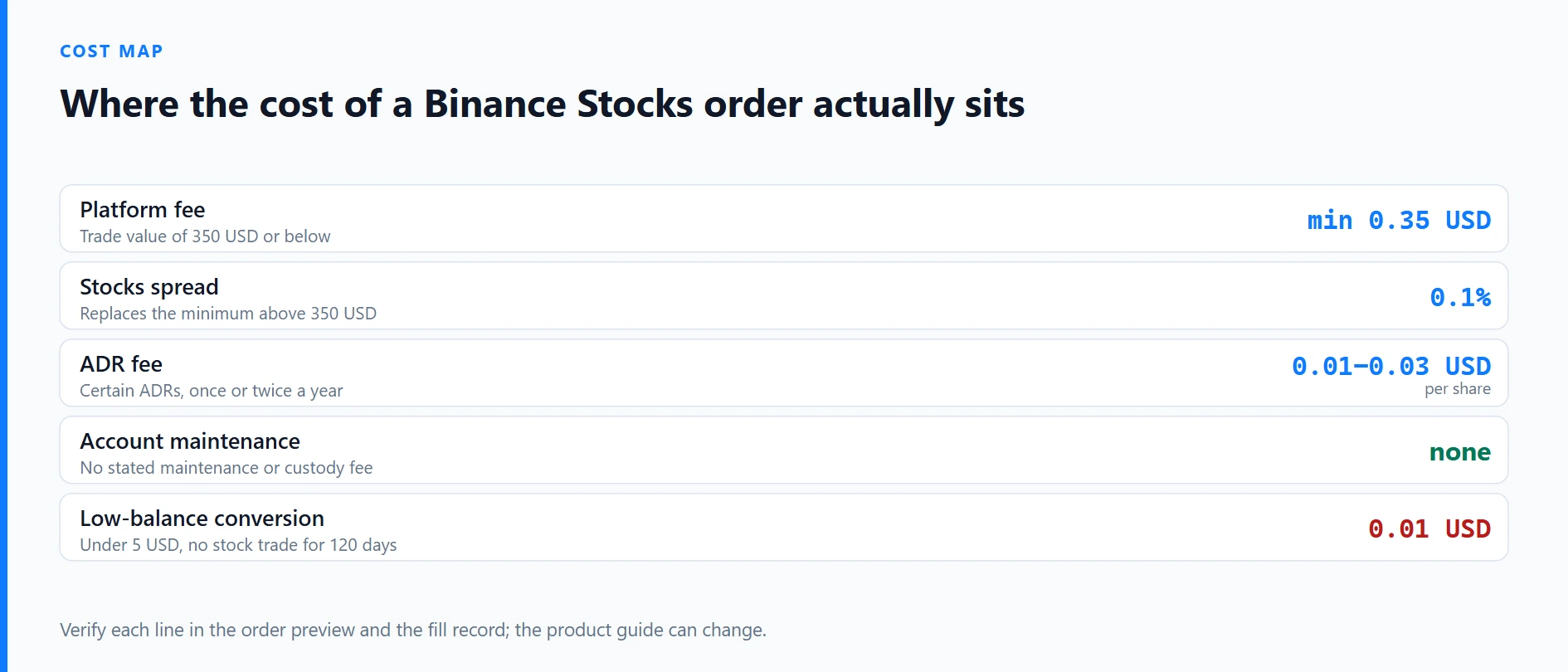
| Platform fee | Minimum 0.35 USD for trade value of 350 USD or below | Every order preview and fill record |
| Stocks spread | 0.1% instead of the minimum platform fee for orders above 350 USD | Preview and executable quote |
| ADR fee | About 0.01–0.03 USD per share for certain ADRs, commonly once or twice a year | Instrument notice and Funding history |
| Account maintenance | No current maintenance, inactivity or custody fee stated for Stocks | Current product terms |
| Low-balance conversion | A holding below 5 USD with no stock trade for 120 days may be sold for USDC with a 0.01 USD fee | Position history and Funding account |
| Other layers | Conversion, regulatory, dividend-related and tax costs may apply | The complete funding and exit path |
The 5 USD minimum investment and the 0.35 USD platform fee are different concepts. The minimum is the stated product threshold; the fee is a transaction cost added under the current schedule. A preview near the minimum should show both the share trade value and the estimated total.
The low-balance rule is also not an “inactivity fee.” Binance says the remaining shares may be sold if the holding is below 5 USD and there has been no stock trading activity for 120 days, with 0.01 USD applied to that sale. This administrative exit rule should be tracked separately from the absence of a general account-inactivity fee.
Effective percentage of the minimum fee
A fixed 0.35 USD has a larger percentage effect on a small order:
| Trade value | Platform fee | Fee ÷ trade value |
|---|---|---|
| 5 USD | 0.35 USD | 7.00% |
| 25 USD | 0.35 USD | 1.40% |
| 100 USD | 0.35 USD | 0.35% |
| 350 USD | 0.35 USD | 0.10% |
These percentages are arithmetic, not a quotation of total cost. They exclude conversion, tax, market spread and any difference between the previewed and executed price.
Five separate 5 USD orders can apply the minimum fee five times, even if they produce the same gross exposure as one 25 USD order. Combining orders only to reduce fees can create a different entry price and timing risk, so cost should be evaluated alongside the investment plan rather than in isolation.
The boundary effect around 350 USD
The official guide says an order above 350 USD uses a 0.1% Stocks spread instead of the minimum platform fee. Under its example, a 400 USDC trade value implies about 0.40 USDC. At 1,000 USDC, 0.1% is 1.00 USDC.
The word spread matters. It can be embedded in the executable quote rather than displayed as a separate cash debit. Compare the Binance preview price with the relevant market bid and ask at the same timestamp, then save the final average fill and total USDC amount.
Do not assume that “0.1% spread” removes the market's natural bid/ask difference. Execution quality can also change with liquidity, order size and session. Extended and overnight trading can have wider prices and less depth than regular US hours.
Avoid manipulating an order around 350 USD solely to cross the fee boundary. A price movement, fractional rounding or revised quantity can change the trade value before confirmation. Refresh the preview and use the exact final tier shown.
Worked buy-and-sell examples
These are hypothetical calculations, not live quotes.
Smaller order
Suppose a 100 USD purchase incurs 0.35 USD and a later 110 USD sale incurs another 0.35 USD. The two platform charges total 0.70 USD. Relative to the original 100 USD, that is 0.70% before conversion, market spread, price movement or tax.
If a user records only the purchase fee, the exit cost disappears from the performance calculation. Keep buy and sell entries separate and then combine them for the round trip.
Larger order
Suppose a 400 USD purchase and 420 USD sale each use the stated 0.1% Stocks spread. The mechanical estimate is 0.40 + 0.42 = 0.82 USD. The live preview and fills can differ because the actual quote, order value and liquidity can change.
For a meaningful platform comparison, use the same security, direction, quantity, timestamp and session. Comparing yesterday's market order on one platform with today's indicative price on another does not isolate fees.
Track ADR fees separately
An American Depositary Receipt represents an interest in a non-US company through a depositary arrangement. Binance's guide says certain ADRs may charge about 0.01–0.03 USD per share, normally once or twice a year, and that the amount can be deducted automatically from the Funding account.
An ADR charge is not the Stocks platform fee and is not dividend withholding. Record the instrument's ADR status, number of shares on the relevant date, depositary notice, charge date and Funding-history entry.
For example, 100 ADR units at 0.02 USD per share would produce a 2.00 USD periodic charge under a hypothetical notice. The actual rate and timing come from the depositary and product record, not this example. A small Funding balance can make an unexpected deduction easier to miss.
Crypto conversion and the exit route
Binance says purchases settle primarily in USDC. The current guide lists USDC, BNB, USDT, U and USD1 as supported funding assets; a non-USDC asset can be converted at order submission, and unused converted USDC is returned to Funding. Share-sale proceeds are also credited as USDC to Funding.
The full cost path may therefore be:
Income currency → crypto asset → USDC → share → USDC → crypto or income currency
For every arrow, record the units given, units received, conversion rate, spread, platform or bank fee and timestamp. Paying with one asset and later measuring the result only in dollars can hide a crypto conversion gain or loss.
Some readers may prefer converting to USDC before the order to separate the records; others may prefer the combined flow. Neither is universally cheaper. Compare the live conversion quote and preserve both histories. The USDC, USDT and BNB funding guide explains where unused balance and sale proceeds are recorded.
Checks before and after the order
Before confirmation, save or write down:
- ticker, share class and whether the instrument is an ADR;
- share quantity, trade value and session;
- Funding or Spot source and payment asset;
- conversion rate and USDC produced, if applicable;
- platform fee or Stocks spread shown;
- estimated total and the price limit, if any.
After execution, reconcile:
- average fill and executed quantity;
- actual platform charge or quote difference;
- conversion entry and unused USDC;
- Funding destination for sale proceeds;
- any partial fill or cancellation;
- CSV or statement record for tax and performance calculations.
A simple effective-cost formula is:
Direct costs ÷ invested amount × 100
Define “direct costs” consistently when comparing platforms. Keep taxes and dividend events as separate records because their treatment depends on residence, treaties, account structure and personal facts. Use the currency, dividend and tax checklist for that second layer.