
Risk & Research
Buying ADRs: Depositary Fees, Currency Risk and Dividend Records
What you own when you buy an ADR, where the depositary fees are disclosed (Form 20-F Item 12.D), how the home currency and foreign withholding change your dividend, and the record to keep, worked through with TSMC and Infosys filings.
An ADR lets you buy a non-US company on a US exchange, priced in US dollars, during US market hours. That convenience hides three things a plain US share does not have: a depositary bank that can charge its own fees, a dividend that starts life in another currency, and a tax withheld by another country. This guide shows where each of those is written down and what to record, using two real annual reports: Taiwan Semiconductor (TSM) and Infosys (INFY).
What you actually own when you buy an ADR
A foreign company's ordinary shares sit with a custodian in the home market. A US depositary bank issues certificates against them. Strictly, the American Depositary Share (ADS) is the unit that trades, and the American Depositary Receipt (ADR) is the certificate that evidences it; brokers and most investors use "ADR" for both.
Two numbers define the unit:
- The ratio. TSM's annual report on Form 20-F states that each ADS represents five common shares. Infosys states that each ADS represents one equity share. The ratio is why an ADS price can look nothing like the home-market price.
- The depositary. For TSM it is Citibank, N.A. As of February 28, 2026, 5,313,450,863 TSM common shares, represented by 1,062,690,167 ADSs, were registered in the name of Citibank's nominee.
Because the ADS is backed by real shares, its price tracks the home-market price converted into dollars:
ADS price ≈ ratio × home-market share price ÷ (local currency per US dollar)
It is a rough link, not an exact one. Trading hours, capital controls and demand for the US line can push the ADS to a premium or discount to that value, so compare both before you assume one is "cheap".
Not every ADR is the same kind of programme. ADRs listed on NYSE or Nasdaq are sponsored by the company, which usually files an annual report on Form 20-F with the SEC. Some ADRs trade over the counter, and some are set up by a depositary without the company's involvement ("unsponsored"); for those, the disclosure you can find in English may be much thinner. If you can't find a 20-F, treat that as a research gap, not a detail.
Where the depositary fees are written
Every 20-F has a section called Item 12.D, American Depositary Shares. It lists what the depositary may charge ADS holders. This is the first place to look, because the fees differ from one programme to the next.
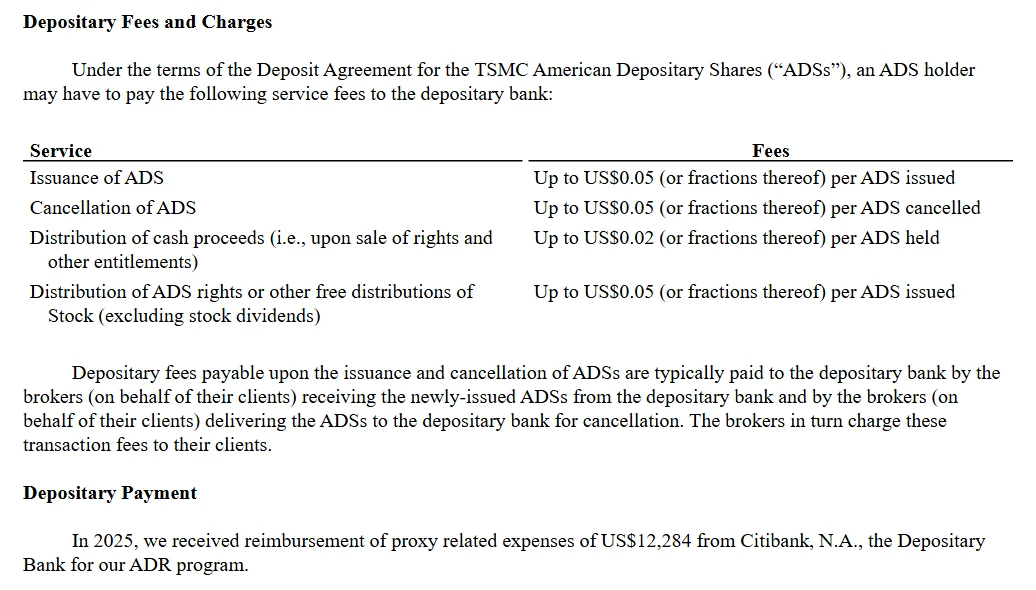
TSMC's 2025 Form 20-F (filed April 16, 2026), Item 12.D. The fees are maximums per ADS.
TSM's table lists four charges: up to US$0.05 per ADS for issuance, up to US$0.05 per ADS for cancellation, up to US$0.02 per ADS held when the depositary distributes cash proceeds (such as from selling rights), and up to US$0.05 per ADS for distributions of rights or other free stock. The text below the table explains that issuance and cancellation fees are paid by brokers, who pass them on to their clients. There is no annual custody fee in this list.
Infosys's Item 12.D is different. Alongside similar issuance and cancellation fees (up to US$0.05 per ADS), it lists:
- up to US$0.01 per ADS for each cash distribution;
- an annual fee of up to US$0.02 per ADS for operating and maintaining the ADS programme.
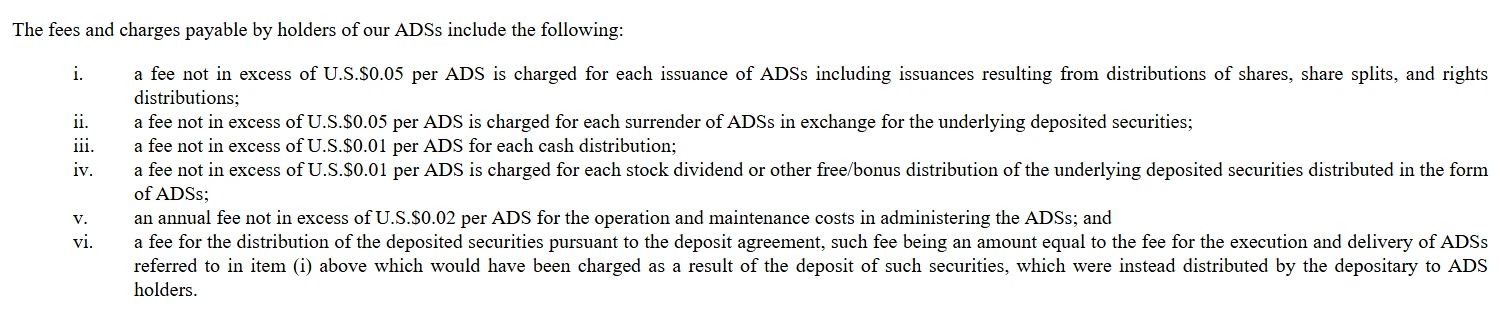
Infosys's Form 20-F (filed June 15, 2026), Item 12. TSMC's fee table is shown above.
So two ADRs with the same share price can carry different running costs. A quick example with Infosys's maximums: holding 200 ADS costs up to 200 × 0.02 = US$4.00 a year in the annual fee, plus up to 200 × 0.01 = US$2.00 each time a cash dividend is paid. If the company paid two cash dividends in a year, the ceiling would be US$4.00 + US$4.00 = US$8.00. These are small amounts, but they are recurring and they show up as separate lines, which is exactly why they get mixed up with tax.
How the fee reaches you depends on your broker or platform. It may be netted out of a dividend or posted as its own charge. If you hold ADRs through Binance Stocks, our breakdown of Binance Stocks fees, spreads and ADR charges shows where that platform says ADR charges appear.
Currency risk: the dividend starts in another currency
An ADR is priced in dollars, but the company earns, reports and declares dividends in its own currency. TSM's 20-F lists its 2025 quarterly cash dividends in New Taiwan dollars (NT$).
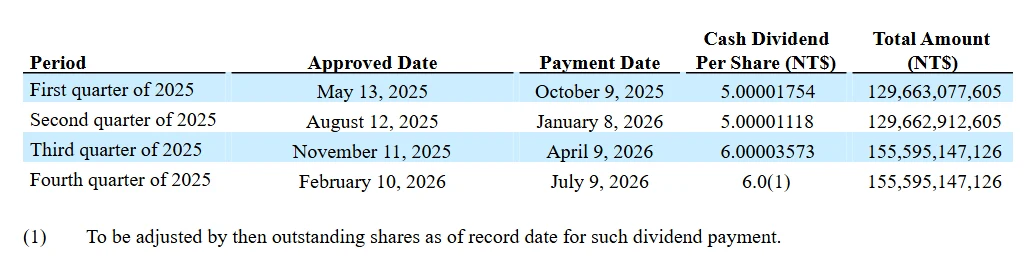
Quarterly cash dividends for 2025 from the same filing (Item 8). Amounts are per common share, in NT$.
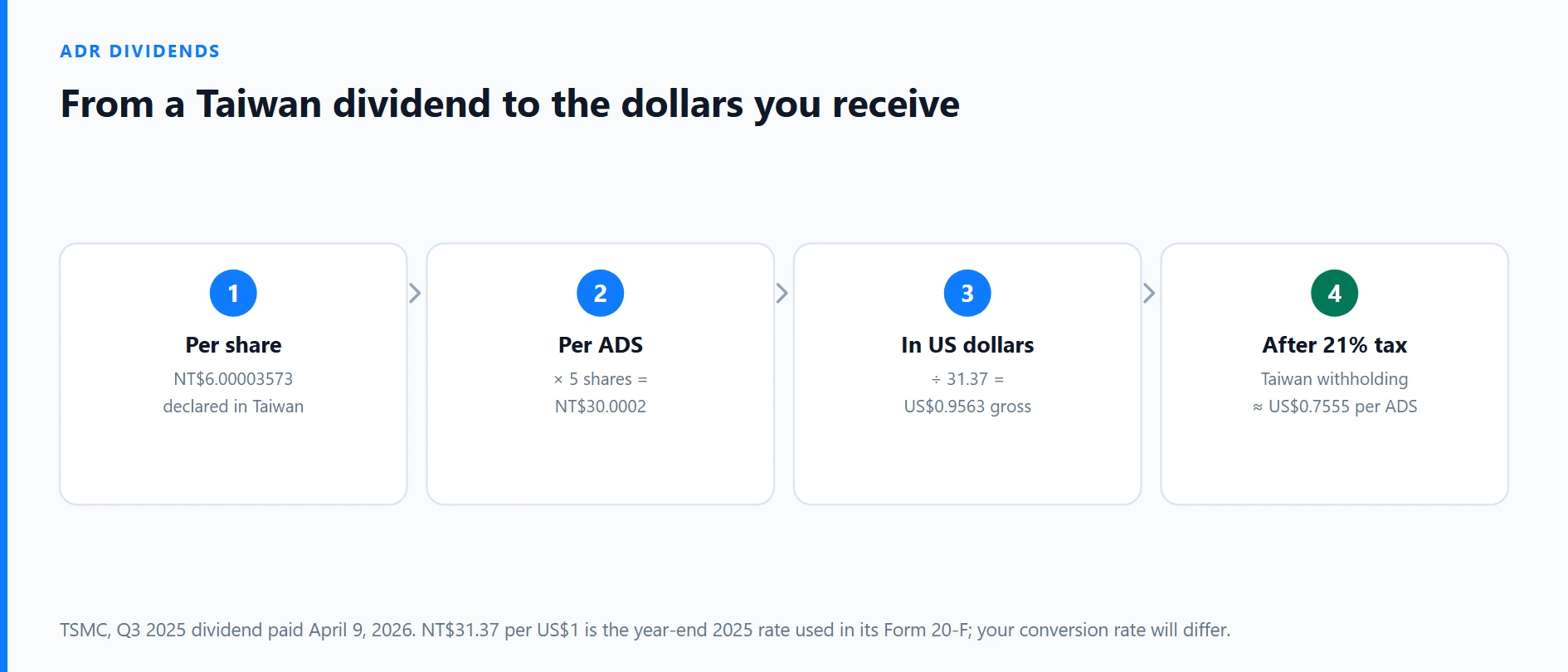
Take the dividend for the third quarter of 2025: NT$6.00003573 per common share, payable April 9, 2026. Per ADS that is 5 × 6.00003573 = NT$30.0002. The depositary receives the cash and converts it; the dollar amount you see depends on the exchange rate used at conversion.
To show how much the rate matters, here is the same NT$30.0002 at three exchange rates. The middle one, NT$31.37 per US$1, is the year-end 2025 rate TSM itself uses for convenience translations in the 20-F; the other two are simply for comparison.
| NT$ per US$1 | Gross dividend per ADS in US$ | Change vs 31.37 |
|---|---|---|
| 30.00 | 1.0000 | +4.6% |
| 31.37 | 0.9563 | — |
| 33.00 | 0.9091 | −4.9% |
The same exchange-rate effect applies to the ADS price itself: if TSM shares were unchanged in Taipei and the NT$ fell 5% against the dollar, the ADS would, all else equal, fall by about the same amount. An ADR gives you US-dollar trading, not US-dollar exposure. If your own spending currency is neither the dollar nor the home currency, you carry two exchange rates: home currency to dollar, then dollar to your local currency.
Whose tax is withheld from an ADR dividend
The withholding on an ADR dividend normally comes from the company's home country, not from the US. TSM's 20-F (Item 10, R.O.C. Taxation) says cash dividends paid to holders are subject to Republic of China withholding tax at 21%, unless a lower rate applies under a tax treaty between the R.O.C. and the holder's country of residence. The same section says gains from selling ADSs are not regarded as R.O.C.-sourced income and are not currently subject to R.O.C. income tax.
Continuing the example at NT$31.37 per dollar, for 100 ADS:
| Line | NT$ | US$ |
|---|---|---|
| Gross dividend (100 × 30.0002) | 3,000.02 | 95.63 |
| R.O.C. withholding at 21% | −630.00 | −20.08 |
| After withholding | 2,370.02 | 75.55 |
Then subtract any depositary fee for the distribution, if your programme charges one. TSM's Item 12.D list doesn't include a per-dividend fee; Infosys's does.
Two cautions. First, the 21% rate is TSM-specific; each country sets its own rate, and the 20-F's taxation section is where to read it. Second, whether that foreign tax can be credited against tax in your own country depends on your local rules and any treaty, which this article cannot settle for you. Keep the record either way. Our checklist for currency, dividend and tax records covers what a platform statement usually shows and what it leaves out.
The record to keep for each ADR dividend
A platform statement often shows only the net dollar amount. That single number blends four things: the dividend, the exchange rate, the foreign tax and the depositary fee. If you need to report the income or claim a credit later, you'll want them separately. One row per dividend:
| Field | Example (TSM, Q3 2025 dividend) |
|---|---|
| Ticker and ratio | TSM, 1 ADS = 5 common shares |
| Depositary | Citibank, N.A. |
| Number of ADS held on the record date | your holding |
| Payment date | April 9, 2026 |
| Declared amount per share, local currency | NT$6.00003573 |
| Exchange rate used | from your statement or the depositary notice |
| Foreign tax withheld | rate and amount (21% R.O.C. here, unless a treaty rate applied) |
| Depositary fee charged | amount, or "none" |
| Net amount received | from your statement |
| Source document | 20-F year and section |
Save a copy of the 20-F you relied on. Fee tables and tax descriptions can change from one year's filing to the next.
Five checks before you buy an ADR
- Find the 20-F. Search the company on SEC EDGAR; our guide to researching a stock on EDGAR shows how to locate the latest annual report. No 20-F usually means less disclosure.
- Note the ratio from the cover page or the listing section (Item 9), and compare the ADS price with the home-market price converted into dollars.
- Read Item 12.D. Write down any annual fee and any per-distribution fee, then multiply by the number of ADS you plan to hold.
- Read the taxation section for the home-country withholding rate on dividends and any treaty reference.
- Decide which currency risk you are taking. You are exposed to the home currency against the dollar, and possibly the dollar against your own currency too.
Sources (checked October 13, 2026): Taiwan Semiconductor Manufacturing Company Limited, annual report on Form 20-F for fiscal year 2025, filed April 16, 2026 (Item 7, Major Shareholders; Item 8, Dividends and Dividend Policy; Item 10, R.O.C. Taxation; Item 12.D, Depositary Fees and Charges; note 3 to the financial statements for the NT$31.37 translation rate); Infosys Limited, annual report on Form 20-F for fiscal year ended March 31, 2026, filed June 15, 2026 (Item 9 and Item 12); both via SEC EDGAR.