
Risk & Research
How Often Should You Rebalance? Calendar, Threshold and Cash-Flow Rules Compared
Three ways to bring a drifted portfolio back to target: fixed dates, tolerance bands and redirecting new money, with a 60/40 worked example and the fee arithmetic that matters on small accounts.
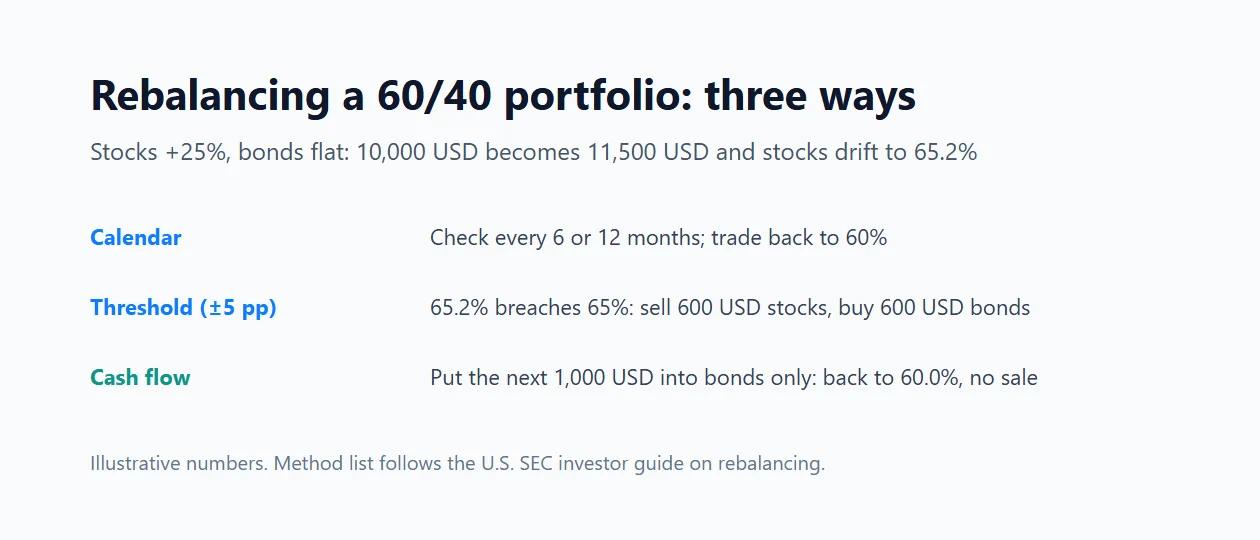
A portfolio you set at 60% stocks and 40% bonds does not stay there. After a good year for stocks it might be 65% stocks without you placing a single trade, which means you are now carrying more equity risk than you chose. Rebalancing is the routine that brings it back.
The U.S. Securities and Exchange Commission's investor guide describes three ways to do it and two ways to decide when. This page turns those into rules you can write down, with one worked example and the trading-cost arithmetic that matters on small accounts.
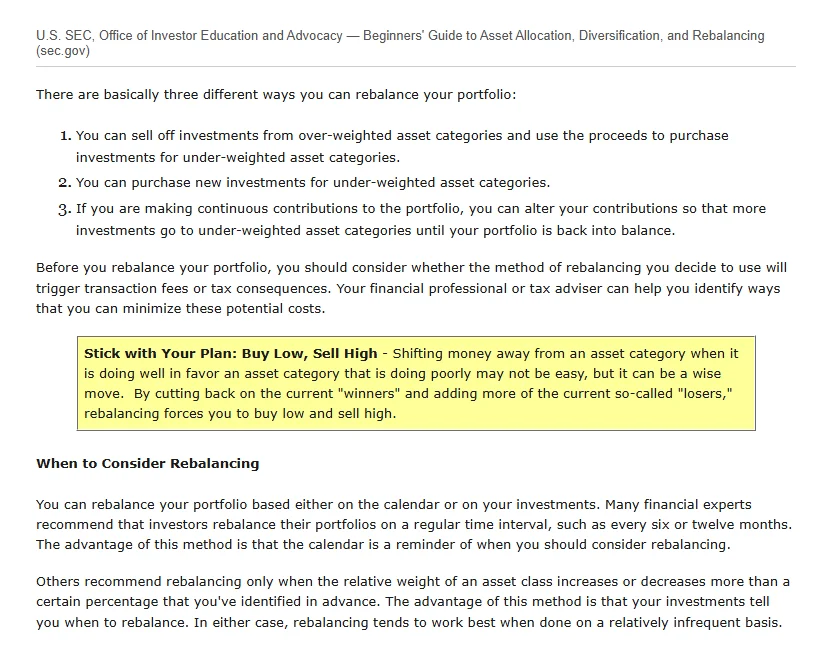
Source: SEC, Beginners' Guide to Asset Allocation, Diversification, and Rebalancing, section on rebalancing.
The worked example used below
The numbers are illustrative, not a forecast:
| Start | After stocks rise 25%, bonds flat | |
|---|---|---|
| Stock fund | 6,000 USD (60%) | 7,500 USD (65.2%) |
| Bond fund | 4,000 USD (40%) | 4,000 USD (34.8%) |
| Total | 10,000 USD | 11,500 USD |
Stock weight = 7,500 ÷ 11,500 = 65.2%. To get back to 60%, stocks should be 0.60 × 11,500 = 6,900 USD, so 600 USD has to move from stocks to bonds.
Method 1: rebalance by the calendar
Rule: on fixed dates, compare each weight with its target and trade back to target.
The SEC guide notes that many experts suggest a regular interval "such as every six or twelve months". Pick dates you will actually keep, for example the first trading day of April and October, and put them in your calendar.
- Good for: people who want a fixed habit and do not want to watch weights.
- Weakness: the portfolio can drift far between dates, and on a date when drift is tiny you may trade for almost no benefit.
- Practical fix: combine it with a minimum drift. On the check date, trade only if a weight is more than, say, 2 percentage points off target.
Method 2: rebalance when a threshold is breached
Rule: set a band around each target in advance and trade only when a weight leaves it.
With a ±5 percentage-point band on a 60% target, the band is 55%–65%. In the example, 65.2% is outside, so you sell 600 USD of the stock fund and buy 600 USD of the bond fund. If stocks had risen 20% instead, the weight would be 7,200 ÷ 11,200 = 64.3% and you would do nothing.
- Absolute bands (±5 points) are simple for large holdings.
- Relative bands suit small holdings: a 10% position with a ±25% relative band trades only outside 7.5%–12.5%. A ±5-point band on a 10% holding would let it fall to half its size first.
- Weakness: you need to check weights often enough to notice a breach. A monthly look at a spreadsheet is usually enough; there is no need to react intraday.
Method 3: rebalance with cash flows
Rule: direct new deposits, dividends or withdrawals so they push weights toward target, without selling.
In the example, putting the next 1,000 USD entirely into the bond fund gives 7,500 ÷ 12,500 = 60.0% stocks. No sale, so no realized gain. Withdrawals work the other way: take money from whatever is overweight.
The cash needed to fix drift without selling is: (overweight value ÷ target weight) − current total. Here 7,500 ÷ 0.60 − 11,500 = 1,000 USD.
- Good for: people still adding money regularly, and investors in jurisdictions where selling at a gain is taxed.
- Weakness: if the drift is large relative to your contributions, it can take months to close.
What each method costs to run
The SEC guide warns that a rebalancing method may "trigger transaction fees or tax consequences". Both are easy to underestimate on small accounts.
Using the current Binance Stocks schedule (a 0.35 USD minimum platform fee for orders of 350 USD or less, 0.1% above that; see our breakdown of Binance Stocks fees and spreads):
| Portfolio size | Trades needed | Platform fees | As % of amount moved |
|---|---|---|---|
| 11,500 USD (threshold method) | sell 600 + buy 600 | 0.60 + 0.60 = 1.20 USD | 0.10% per side |
| 1,150 USD (same drift, scaled down) | sell 60 + buy 60 | 0.35 + 0.35 = 0.70 USD | 0.58% per side |
| 11,500 USD (cash-flow method) | one buy of 1,000 | 1.00 USD | 0.10% |
The fee shown on the order preview is what counts; check it before confirming, along with the bid–ask spread. Selling may also create a taxable gain under the rules of your jurisdiction, which is often the bigger cost and the main reason to prefer the cash-flow method when you can.
A simple guard: set a minimum trade size and skip any rebalancing order below it. On the schedule above, orders under 100 USD lose more than 0.35% to the fixed fee alone.
Write your rule in one paragraph
A rebalancing plan is only useful if it is decided before markets move. A template:
Targets: 60% stock fund, 40% bond fund. I check weights on the first trading day of each month. I rebalance when a weight is more than 5 points from target. I first use new deposits and dividends; I sell only if cash flows cannot close the gap within three months. I do not place rebalancing orders below 100 USD.
Two related checks are worth running at the same time. If a single company or industry has crept up inside the stock sleeve, measure look-through concentration before deciding what to trim. And if you are rebalancing individual positions rather than funds, size each one from your risk-per-trade budget instead of rounding to a neat dollar figure.
Common mistakes
- Rebalancing to a target you never wrote down. Without a fixed target, "rebalancing" becomes selling whatever feels expensive.
- Treating drift as a signal. The point is risk control, not a market call. The SEC guide frames it as buying low and selling high by rule, which only works if you follow the rule when it feels wrong.
- Ignoring what sits inside an asset class. The guide also says to review the investments within each category, not just the stock/bond split.
- Trading too often. The SEC notes rebalancing "tends to work best when done on a relatively infrequent basis". Many small trades mostly add fees.
Last checked: 20 October 2026. This page explains a method; it is not personal investment or tax advice.